Earlier tonight, Brian (who is the co-owner of the land I’m farming on) arrived home triumphant, holding a 10 pound wild Chinook salmon he caught while out on the nearby Nehalem Bay in a row boat. He carried the fish with a certain pride and excitement, exhilarated at his success. He had about ten hours invested in catching the Chinook, providing–from a purely utilitarian perspective–a reasonable exchange of a pound of fish per hour of work. From a physical and spiritual standpoint, on the other hand, he had traded a combination of play and work for unmatched sustenance.
After Ginger and I admired the fish for a few moments, Brian unearthed a new fillet knife and soon we both stood over his catch, laid out on a wooden table outside. Brian carefully slit open the fish’s belly, made a few cuts around the gills and then began to scrape out the guts of what turned out to be a male fish. It was fascinating to watch. I couldn’t help but think that the fish’s interior seemed surprisingly simple and well-organized. It was not a mess in there, which on some odd level is what I expected. The organs were well-arranged, packed tight but functional, each residing well in its place. The fish’s body was purposeful. Brian’s cleaning of it was, as well.
As Brian opened the fish, cutting each side of flesh away from the bones, he accidentally left a few good pieces of meat still attached. These he went back to and sliced off carefully. We shared in these fresh, raw strips of the Chinook, eating them both in celebration and with a certain reverence. I’ve never eaten raw salmon in that way and so it was both a new experience and a treat. The taste was mild, the texture somewhat chewy but not unpleasant. I could feel my body responding to the meat. It not only tasted good, but felt good.

Our farm kitten, M, inspects and tastes the Chinook.
Once done cutting the fish, Brian temporarily hung the remaining carcass on the fence, intending to pack it away later to be used as crab bait. As the cats quickly discovered it and began inspecting, playing with and nibbling on it, we retreated into the main house with our bounty. The wood stove, fired up in search of hot showers on this surprisingly cool August evening, awaited the Chinook and Brian obliged with half of the fish, settling it onto a metal pan and sliding it into the oven unadorned. He had caught the fish at 7:20 that evening. Within an hour, we were eating raw strips of it. By 8:45, we were eating cooked, dripping pieces of it. The flesh was tender, flaky and delicious. The belly meat was like butter. We ate it with our fingers, walking back and forth between the salmon on the counter and the hot wood stove, marveling at the amazing taste, the incredible texture, the gift of this food–this creature.
And it was a gift. It was a gift of nourishment, of the passing of one life to provide for others. It was a gift of the amazing fertility that still exists within the local land, despite all the abuse and degradation it’s received in recent decades. It was a gift of Brian’s work, his play, his desire to teach me, and of this community I live in. But it also was a gift of connection to a tradition and culture rooted here in the Northwest. Tonight, we ate fresh salmon with our fingers, bound by the sharing of that food and the sustenance provided us by the land and sea. We did this much as past communities, tribes, and native cultures have. We shared in a human tradition that extends back thousands of years and derives from this land and the interplay of its inhabitants, both human and nonhuman.
Tonight, we laid claim to and celebrated this tradition. We did it with our hands: piece by piece, taste by taste.
To Begin With
I’m currently living with an evergreen blackberry.
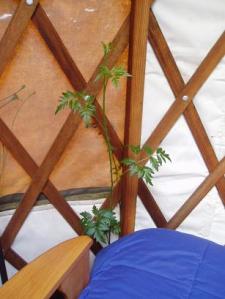
The blackberry in the middle of July.
It’s growing up out of the earth through a very tiny crack between the bottom of the wall and the floor of my yurt. It’s dark green, with jagged leaves, a stalk that thickens by the day and thorns that grow ever more sharp and substantial. It’s growing by the corner of my bed and every day it overhangs that edge–the corner of the head of my bed–a little more.
Luckily, I don’t tend to sleep on that side of the bed. This is good, because I’ve been stabbed in the skull with a blackberry thorn before–while harvesting those ever-alluring berries–and I can’t say it’s an experience I’m particularly eager to relive. Certainly not in the middle of the night.
But To First Backtrack
I’m living in the aforementioned yurt because I’m interning on a small, off-the-grid, organic farm called R-evolution Gardens, located on the Oregon coast. I’ve been here nearly five months and will be here longer yet–at least through Thanksgiving and likely beyond. The yurt’s part of the deal: room and board in exchange for my work on the farm. It comes with a Jøtul wood stove, fantastic (and laden) bookshelves made in part with small alders off the land, a colorful desk, a (futon) bed and, finally, that neighborly evergreen blackberry vine. The vine, of course, wasn’t here in March when I first moved in. It’s a relatively new addition, having been around since the beginning of July.
Now, I’m familiar with blackberry bushes. Back in 2006 and 2007, I did two eleven-month AmeriCorps terms of service, working on a field team doing environmental restoration work. Often times that involved removing invasives, and it was not uncommon for said invasives to be Himalayan and evergreen blackberry. They are beasts, terribly vigorous and not a plant to take your eyes off of for a moment. They spread fast and with little mercy for whatever’s in their path. Trees, shrubs, various native plants, perhaps a particularly still human being–they will happily swallow all, never slowing down to consider whether or not it’s fair for them to be devouring so much land.
A bit like modern humans, no?
In the process of this growth, they’ll create massive tangles of thorny vines that are quite capable of tearing flesh and anything else they come into contact with. They also will create garish, gnarly root balls which can keep them growing and expanding for long periods of time. These root balls turn blackberries into zombies. Kill them all you want, but they’re going to come back. You can chop back those vines time and again, sever them right at the surface, and they’ll still come back. Do it over and over and over again for years, with the right timing, and you may be able to kill them off eventually, but what you really need to do is dig up that root ball. Because if you don’t, the next thing you know, that blackberry’s going to be growing right up into your home.
Enough About Blackberries–For the Moment
This is my third farm internship. Last year, I lived in Portland, Oregon (oh, home!) and farmed at Sauvie Island Organics. The year before that, 2009, I lived my first farming experience at Rosehip Farm and Garden, up on Whidbey Island in the Puget Sound (a bit northwest of Seattle, essentially.) Rosehip was a brilliant introduction to farming, showing me the glorious sort of life that can grow from organically farming a small piece of land while living on that land, engaging in a simpler life and feeling far more connected. I lived in a tiny airstream trailer and the first time I strolled out of my trailer and across the field to our onion beds, snagged an onion from the ground, peeled the dirty layers off as I walked back to my trailer, and then chopped and added it, fresh as could be, to my dinner . . . well, let’s say I was a bit hooked on the farming life. It quickly felt as though I would never be able to go back.
Unsurprisingly, I never have.
In actuality, I’ve simply moved farther down the rabbit hole. Along with a love of growing and eating good food, I’ve discovered over the last some-odd years that I love to homestead. I often make the joke that what I really want is simply to be some lovely woman’s housewife, but it’s not really much of a joke. If I could stay home all day and cook and preserve food, make cheese, brew beer, bake a wide variety of breads (from hand-ground flour!), ferment anything I can get my hands on, churn my own butter and make my own sour cream and creme fraiche and buttermilk, brew up kombucha and ginger ale, roast my own coffee, cure my own bacon, and so on and so forth, I would be an extremely happy man. However, I haven’t yet found that lovely woman who will support me financially while I indulge such endeavors, so for the moment I’m left fitting these projects into my free time.
Of course, that means that my farming and homesteading have grown organically (so sorry) over the years, evolving slowly and concurrently with my similarly-evolving philosophy about life, the natural world, and the way we humans live in it. In between farming and homesteading and various other activities, I’ve spent quite a bit of time reading the works of a wide variety of authors, many of them environmentally conscious. Wendell Berry, Derrick Jensen, David Ehrenfield, Paul Hawken, Annie Dillard, Richard Louv, Gary Paul Nabhan, Thomas Berry, Bill McKibben, Joanna Macy and others have burrowed into my brain with their words, helping to lead me to a radical reevaluation of what it means to live in this world. These readings, coupled with a few years of reconnection to the land via farming and a significant distancing from the dominant culture and economic system, have brought me to a new way of understanding the world and have left me unable to reengage with business as usual. Further, they’ve altered my ways of thinking and have left me making and noting connections that I could not see before.
And So a Blog
I am a writer. Sometimes I qualify that statement with an “occasionally” or a joke about being a writer who does not write. But I do write, even if not always, and I intend to write quite a bit on this blog. This website is being started mainly to provide myself a venue for the exploration of these new connections I’ve been making, the new thoughts I am thinking, and for the cataloging of the experiences that give birth to these connections. This will include longer, more formal essays as well as short vignettes and the relating of observations, stories and activities. There will be the cataloging of farming life, homesteading activities, stories of hikes in the woods, encounters with other creatures, and small meditations on what it is to be human, to be in this world, and how one might work, live, play and love well. The thoughts and considerations will come from experience, from my life and the lives of others, both human and nonhuman, from my readings, from my successes and failures and from the challenging words and thoughts of others–including, hopefully, this blog’s readers.
I want to share how I came upon this path and where it leads me. I hope to do this not just for my own better understanding, but also to inspire and challenge others. Because, to be blunt for a moment, our society is extremely screwed up and its going to take a whole lot of us realizing that deep level of corruption and bankruptcy to disengage from the dominant culture and forge a new one. Luckily for those of us who want to do this, this is an extremely rewarding and joyful undertaking. It’s amazing how much more satisfying life can be when you start to find your true place in this world and begin to understand how to live well in it.
The Other
So I return to the evergreen blackberry that has found itself cohabiting with me. It has grown quite tall now and, yet, has begun to blend into the background. This is not so much because it is less visible, but because I have normalized it. Upon first discovering the blackberry, it nearly shocked me. However, there are blackberries all over our farm, which we constantly work to keep in check. They are remnants of its former use as a staging area for logging of the local land. They are the signifiers of previous abuse, a colonizing species brought forth by abuse of the land. To find one on the farm is not surprising at all. My yurt, however, is a particular place–a circle of human space, walled off from the outside world and supposedly controllable. It is, it seems to me, not a proper place for an evergreen blackberry.
But that is only because I did not introduce the blackberry and because it made its way into my yurt of its own volition. If I had chosen to bring the blackberry into my living space within a pot, I would not look at it strangely. I would in fact care for it, water it, feed and dote upon it, making sure that it received enough light and worrying if it began to look sickly. In other words, if I controlled it, I would find it acceptable. It’s the fact that I don’t control it that makes it odd. It is another creature–the other–and, thus, does not belong in my home.
At least, that was my initial reaction. I quickly questioned that reaction, though, and wondered if I should not leave it to its own devices. I could always change my mind and cut the vine off at the base, reestablishing the previous order and slowly forgetting about that brief appearance of an uncontrolled guest in my home. Why not? I thought. And so I did.
To Return To The Present

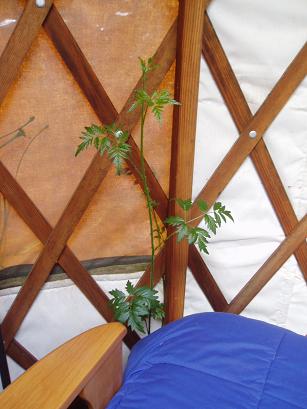
The blackberry now, near the beginning of August.
It is taller than that first picture shows, now approaching the roof. At a certain point, it began to hang too far over the bed due to its increasing weight, so I tucked the blackberry up against the wall, latching it enough to the crisscrossing wooden framework of the inside of the yurt so that it would stay there, rather than dropping upon my face in the middle of the night. There is a second vine, almost as tall as the first. At some point, I suspect I’ll have to cut them both down, yet I can’t find much motivation to do that while they still present me no significant problems.
See, this is one of those moments in which–silly as it may seem, to be uncertain as to whether or not to allow this blackberry to continue to grow in my yurt–I feel compelled to play with expectations, both my own and society’s. It would be logical to cut down these blackberry vines. At the same time, though, they present a fantastic learning opportunity. I observe this blackberry much closer now that it’s in my home than I would if it were outside. I notice its growth and change, the color of its leaves, the breadth of its thorns. I examine, curiously, how well it will grow in diffused, nondirect sunlight. The answer, so far, has been, “Quite well.” I suppose this is an unsurprising observation, considering how well blackberries seem able to spread within the shade. Still, it’s an observation born of direct experience and, as such, might better linger.
A Tying of Loose Ends
Upon first seeing the blackberry growing in my yurt, I wanted to remove it. On further consideration, I decided to live with it. The desire to remove it seemed rash. It appears to not be harming the yurt in any appreciable way and there is no one but me to suffer the mild consequences of living with the plant. Therefore, why not hold off on decisions and allow myself time to consider and learn, to observe, and to perhaps come to some new conclusions? Much can be gained by living with someone other than yourself and little would have been gained by immediately removing the blackberry. I would have already forgotten it and any consideration of the intertwining of our lives would have likely ceased upon the blackberry’s removal.
My reaction to the blackberry and my creation of this blog, then, come from similar intent. I want to study, consider and observe in an effort to better understand how to live, work, play and love well in this world. My interaction with the blackberry is one small manifestation of that effort; this blog will serve as a partial written record of that effort. With luck, it will also grow into a community of people engaging in similar efforts, gaining knowledge and inspirations from my posts while simultaneously providing me with their own knowledge and inspiration. That would be a blessing, for we have much good work to do and too few people who know how to do it. The more we teach each other, the better care we will take in our work and the healthier the world will be.
Let’s get started.


 Of The Hands