Archive for the ‘Work’ Category
An entry in The Household Economy
— ∞ —
“A system of specialization requires the abdication to specialists of various competences and responsibilities that were once personal and universal. Thus, the average—one is tempted to say ideal—American citizen now consigns the problem of food production to agriculturalists and ‘agribusinessmen,’ the problem of health to doctors and sanitation experts, the problems of education to school teachers and educators, the problems of conservation to conservationists, and so on. This supposedly fortunate citizen is therefore left with only two concerns: making money and entertaining himself. He earns money, typically as a specialist, working an eight-hour day at a job for the quality or consequences of which somebody else—or, perhaps more typically, nobody else—will be responsible. And not surprisingly, since he can do so little else for himself, he is even unable to entertain himself, for there exists an enormous industry of exorbitantly expensive specialists whose purpose is to entertain him.”
— ∞ —
I suppose specialization is a feature, and not a bug, of the modern, industrial economy. To run such a complex and industrial infrastructure as we have come to rely upon, we need millions of people carrying out very specific and specialized tasks. This infrastructure is made up of uncountable widgets and devices and roles that all have their own particularity and that, thus, require their own particular machines or trained humans to be run and maintained. Broad classifications of generalized and necessary economic activity have been broken apart and splintered into much more specific niches, and then have been absorbed as a fraction into a far more sprawling beast we might refer to as the discretionary economy. In today’s industrial economy, the necessities of life—food, water, shelter, a clean and functioning environment, community—are now almost an afterthought to the vast and consuming industry of non-necessity: distraction, destruction, profit-driven specialization, a massaging of and attentiveness to human ego both impressive and horrifying. We have discovered an infinite number of economic niches driven not by the particularities of place and community—which would be the basis of niches in a functioning and sane economy—but on the basis of catering to the human ego by creating an infinite number of variations on conformity so that we might convince everyone that, no matter how much they immerse and then lose themselves in the base homogeneity of our culture, they truly are a unique human being, as proven by their particular combination of iPhone apps, or which of the many Nabisco snacks they prefer, or which Anheuser-Busch-owned beer they drink.
Of course, as we’ve created this insanely complex yet oddly generic economy and industrial base, we’ve come to worship at the alter of specialization. We know that we need years upon years of education and training so that we may be successful in today’s high tech, globalized economy. We know that to seize the bright future that is rightfully ours, we must *insert cliche here* so that *tribal term here* may compete in today’s *overtly positive economic buzzword here*. And we know this because we’re told it again and again, each time with slightly varying terms, and always emerging from the mouth of a respected “leader” or, even better, a certified expert.
For in today’s world of hyper-specialization, we have a never ending supply of experts always streaming across our television screens and popping up on the internet, ready and willing to tell us something that we desperately need to know but that we don’t know because we lack the training and intelligence and bottom-of-the-screen label that this particular expert does. In a world, after all, in which specialization reigns supreme, it only makes sense that we have an expert for every conceivable situation—and that we rarely have more than one expert for any particular situation. By embracing the idea of specialization, defining the industrial economy as the greatest economy that has ever existed or will ever exist, and celebrating every new fragmentation of our lives as a matter of great progress, we’ve created the necessity for this multitude of experts. By proclaiming that the height of human ability is to be trained in one very specific task and to be the sole person capable of performing that task—or to be the very best at that task, even if other people fumble through their own inadequate attempts at said task—then we condemn ourselves to, at best, being extremely good at one or two things and very bad at everything else. Or, if not very bad, then at least inadequate—unable to stake our claim to that task with the sort of legitimacy that a real expert would.
— ∞ —
“The beneficiary of this regime of specialists ought to be the happiest of mortals—or so we are expected to believe. All of his vital concerns are in the hands of certified experts. He is a certified expert himself and as such he earns more money in a year than all his great-grandparents put together. Between stints at his job he has nothing to do but mow his lawn with a sit-down lawn mower, or watch other certified experts on television. At suppertime he may eat a tray of ready-prepared food, which he and his wife (also a certified expert) procure at the cost only of money, transportation, and the pushing of a button. For a few minutes between supper and sleep he may catch a glimpse of his children, who since breakfast have been in the care of education experts, basketball or marching-band experts, or perhaps legal experts.”
— ∞ —
Such a world of experts is the wet dream of the industrial cornucopian. We are told constantly that the mark of a great economy is efficiency. We must grow our citrus only where citrus grows best, our apples only where they grow best, mine our metals only where they are easiest to mine, derive all our energy from centralized power plants producing the most possible energy with the least amount of human labor, build our machines where the taxes are the lowest and the energy is cheapest and most abundant and the labor is low-cost and compliant, make our butter and cheese in vast factories where machines do the work and every bit of wasted energy can be cut out, then ship that cheese and butter all around the world. We must take every meaningful human activity, load it into a spread sheet, determine how to transfer the activity to machines, cut out as many humans as possible, destroy as much of its meaning as possible, commoditize it, cheapen it, degrade it, divvy it up, and declare success. We must find wholes and reduce them to pieces, mechanize them, specialize them, burrow down into their specific depths and obsess over the details and forget always any inherent or overarching meaning, forget anything that the pieces might make together. We must never see the forest; only the trees, and then only the value in cutting them down. We must eliminate God or any semblance of God at every turn, for God only confuses the issue. We must destroy any sense of the sacred. It clouds our vision. Lastly, we must declare science and economy our new God, make them sacred, and then proclaim our vision finally clear. With this clear vision, we will specialize everything, reduce all we can see, proclaim our knowledge and wisdom infinite, and worship experts—all for the unequivocal good of humanity.
But where is this good? A life in the hands of experts is supposed to be the perfect life. That’s why we have all these experts in the first place—so we can avoid mistakes and engage our lives only in the most effective of ways. And yet, we seem in many ways a miserable and perpetually unsatisfied people. Things never are perfect but we yearn to make them so. It’s a paradox—our cult of the expert should provide us constantly expert advice, which should provide us the means to live our lives perfectly. But there’s nothing paradoxical about this at all. It makes perfect sense that in a society that worships experts and the idea that all tasks should be carried out to perfection that we find ourselves constantly unsatisfied, always searching for the perfection we can’t seem to grasp. And that’s because, rather than attain any kind of perfection, we’ve simply altered the expectations of our society, creating desires that are unfulfillable.
Seeing perfection as a possibility, we yearn for it and sense that if we can attain it, we will be perfectly happy. In our efforts to attain it, we pay attention to the experts who are supposed to know how to attain perfection—who are supposedly practitioners of it. Yet there are two problems with this approach. First and foremost is that perfection tends to be an unattainable ideal. Or, more specifically, it’s an unattainable ideal for humans. It’s a much more attainable ideal for machines, and therein lies one of our problems. Since we have allowed our thinking to be distorted by our industrial economic base, we tend now to think in mechanistic terms rather than in the animalistic terms that are natural to us as human beings—as animals. Our ideas of perfection are rooted in mechanical notions. They’re based on reductionism, strictly-defined variables and controlled circumstances. By homogenizing and standardizing the scenario in which we attain perfection, we should be able to homogenize and standardize the perfection. We define the scenario, define the desired outcome, and then use those defined realities to create the steps we need to take from scenario to desired outcome. This often works in the realm of machines. If we have a human-made screw that needs to be screwed into a human-made panel, we can create a human-made machine that will work within strict parameters to screw that screw into that panel. Every element of the scenario is controlled by us, the outcome is defined by us, and thus we are able to create the fulfillment of that outcome.
But that’s not how human lives work, now is it? If we want to raise our children well, there’s not an expert in the world who can define the full breadth of the scenario of raising children, define a final goal (what does it mean to “raise our children well?”) and then provide us the steps to get there. It can’t be done because the scenario cannot be defined and controlled by humans, nor can the outcome be so controlled, at least not completely. There are far too many variables, far too many elements, far too many other creatures involved, far too much unpredictability and lack of control. Human lives do not unfold within the same paradigm as our mechanistic creations do, and so attempting to attain perfection as defined in mechanistic terms is doomed to failure.
There is, however, an even bigger problem with our attempts to attain perfection and thus be happy, which is that perfection doesn’t make us happy. I suspect some people might argue that point, and I imagine there are even a few exceptions out there to this rule. But I firmly believe that perfection would lead to human misery—utter boredom. Even if there was some way to define and then achieve perfection in the realm of human life, why would we want to do so? How could that produce happiness? The happiness we feel as humans stems out of the inherent messiness of life. We need our successes and failures, our joy and pain, our horrors and contentments. Without these contrasts and these back-and-forths, we can’t appreciate any of this life. It’s a terribly old idea, but you can’t appreciate light without dark. We can’t be happy if we don’t know sadness and misery. We can’t enjoy our successes if we’ve never known failure.
Imagine the happiest moments of your life and tell me whether or not you understand them without contrasting them against other moments of your life. I’m not saying you always think of dichotomies when you think of happiness, but I do think it’s lurking there in the back of your mind if it’s not in the forefront. When I think about the joy of waking up in the morning next to someone I love, then maybe having some coffee and a leisurely breakfast, I understand the joy of that in contrast of waking up alone on a cold morning, knowing I have to go to work. Now, that first scenario may not be perfect and that second one may not be horrible. Perhaps I like my work, even if I really don’t want to get out of bed and prefer the idea of sleeping in. Perhaps the breakfast with my significant other isn’t that satisfying or we get into a small argument, or there’s a clash of desires. But whatever form of perfection I might see in the first scenario, I need the second scenario to appreciate the first. This is simply the juxtaposition of comforts I’ve written about before. We need a wide breadth of experiences to better understand those experiences. We need to be able to compare and contrast, to work different sensations off each other so that we may better learn those sensations.
We’ve attempted to eliminate the messiness from human lives, but in so doing we only are making ourselves less happy. Our joy comes from that messiness, even if our misery does as well. It’s the point of being human. What could we possibly have to do here if we were here only to live a perfect life? Why even bother?
— ∞ —
“The fact is, however, that this is probably the most unhappy average citizen in the history of the world. He has not the power to provide himself with anything but money, and his money is inflating like a balloon and drifting away, subject to historical circumstance and the power of other people. From morning to night he does not touch anything that he has produced himself, in which he can take pride. For all his leisure and recreation, he feels bad, he looks bad, he is overweight, his health is poor. His air, water, and food are all known to contain poisons. There is a fair chance that he will die of suffocation. He suspects that his love life is not as fulfilling as other people’s. He wishes that he had been born sooner, or later. He does not know why his children are the way they are. He does not understand what they say. He does not care much and does not know why he does not care. He does not know what his wife wants or what he wants. Certain advertisements and pictures in magazines make him suspect that he is basically unattractive. He feels that all his possessions are under threat of pillage. He does not know what he would do if he lost his job, if the economy failed, if the utility companies failed, if the police went on strike, if the truckers went on strike, if his wife left him, if his children ran away, if he should be found to be incurably ill. And for these anxieties, of course, he consults certified experts, who in turn consult certified experts about their anxieties.
It is rarely considered that this average citizen is anxious because he ought to be—because he still has some gumption that he has not yet given up in deference to the experts. He ought to be anxious, because he is helpless. That he is dependent upon so many specialists, the beneficiary of so much expert help, can only mean that he is a captive, a potential victim.”
— Wendell Berry, The Unsettling of America, (p. 19-21)
— ∞ —
The industrial, globalized economy is the attempt at perfection. It’s the height of our mechanistic dreams, our specializations, our worship of experts, our attempts at control. It’s us not figuring out how to live well within the messy realities of life, but our attempts to control and purify that life, to make it work well no matter what. It’s our attempt not to find our happiness and satisfaction from within, but to impose perfection upon ourselves from outside—to control our outer environment so that we don’t have to concern ourselves with our inner environment. As such, it is an outer economy. We go to work. We leave the home. We tap outside forces to guide and maintain that economy and then we insert ourselves into it, into our very controlled and defined niche.
The household economy is much more messy, at least in terms of how we think of messiness. The household economy necessitates that we deal with ourselves, that we work within the uncontrolled variables of life. We don’t go to work in the household economy. We live there. We don’t leave the home to engage in the household economy. We stay in the home. We don’t give control of the household economy to outside forces. We control it ourselves. We don’t standardize the household economy. We make it our own and each household economy exists only in one specific home.
Similarly, the household economy is a complete affront to the cult of the expert. We should not be making our own butter; a machine should be making it, and it should be strictly controlled. We should not be making our own cheese; a machine should be making it, or a master cheese artisan should be crafting the finest cheese. Our households are not efficient. In fact, the household economy is necessarily inefficient, at least in the insane way in which we define efficiency in the industrial economy. Rather than trusting our livelihoods to machines, the household economy is about bringing our livelihoods back into our homes and into our own hands. It’s about replacing machine labor with human labor and embracing all the messiness, variability and lack of control that entails. It’s about embracing that lack of industrial perfection in the pursuit of human perfection—in that animalistic mix of trial and error, of frustration and success, in the inherent joy of creating things with our hands, of making our own life and living with the contradictory results of that process. It’s about working with the outside world rather than controlling it, and instead finding our joy in the inner familiarity and satisfaction gained slowly through good work and a life well lived.
The household economy rejects perfection in favor of experience.
That’s not to say, however, that the household economy is devoid of craft, care or expertise. Indeed, I would say the household economy features care as a matter of course, very commonly features greater craft than the industrial economy, and will often, as a matter of course, feature expertise. It takes all of these elements as part of a broader experience, though, and is not afraid to mix and match. The household economy, again, is messy. In that messiness, it’s beautiful and it’s sacred and it’s fulfilling in a way that the industrial economy almost never is. The household economy, after all, is run by humans. The industrial economy is run by machines.
As I write and advocate for the household economy in this series of posts, one of the core values is going to be a rejection of the cult of the expert. This is necessary for the household economy. If we constantly seek the sort of mechanistic perfection advocated by this cult, then the household economy can never be successful. It functions only under different ideals, different pursuits, different goals. It functions only in the real world of human care and experience, not in the mechanistic world of industry. And so one of the foundations of this series is that we all get dirty without worry of perfection, that we all be willing to make mistakes, and that we all find joy in the experience as much as in the outcome—and that we find joy in the experience regardless of the outcome.
The projects won’t always be successful when defined strictly under the terms of the desired final outcome. But they’ll always be successful when taking into account experience, the pleasure of the work, and the sense of ownership that comes from an act of making one’s own living. And while I’ve dared to throw some religious terms in this post, I’ll say once more that they also will be successful in the sense of engaging in something sacred, however you define that term. Peter Berg, in an interview in Listening to the Land quoted a woman from Mexico City who said that “the kitchen is the place where you worship the earth.” I dare say much more good can be done in the kitchen than in a factory—and that God, in whatever form, can much more easily be found in the kitchen, as well.
In the household economy, we become generalists. We may occasional stumble upon something that makes us, in that particular instance, want to become a specialist, and there’s nothing wrong with that. If we find we love making cheese, we may want to delve deeper into that craft and work to become a craftsman cheese maker. But in general, the household economy is about working as a generalist and finding our love of the work and its outcomes not necessarily in the perfection of the final product, but in the perfection of the work, in the meaning of creation, and the satisfaction of each bit of self-reliance and personal care.
In that sense, each of us has the potential to be an honest expert—someone whose expertise is rooted not in ingraining pervasive dissatisfaction but in caring for ourselves and making our own small satisfactions and moments of true perfection, seen only in the inherent and sprawling messiness of our humanity. Someone whose expertise is rooted in work, not in theory. Someone whose expertise recognizes the folly of perfection and strives instead for joy, good work, and care.
Regular readers may have noticed it’s been over a week since the last post, which is a longer wait between posts than normal here on this blog. I intended to have something up on Tuesday, then on Thursday, and then again yesterday night, but I kept pushing back the writing. Partly that was due to some of the usual distractions in my life and partly to being on the train for two days and then returning home to work for three straight days. But it’s also been a matter of spending a good chunk of the week mulling over new ideas but not quite teasing them out to a level of coherence ready for a full write up.
One of my goals with this blog of late is to write on more fully formed ideas, rather than write on new ideas that I haven’t had a chance to mull over for a bit. I make this a goal because I write higher quality posts under that ideal. There’s nothing surprising about that, of course, as taking the time to think through the various implications and pitfalls of a new idea can lead to a clarity and coherence that often is lacking in our discourse. I have multiple times had the strike of an insight from which I wanted to immediately write up a rhetoric-heavy essay to only, upon further consideration, realize that the insight is deficient, or incorrect, or simply incomplete—sometimes silly, sometimes promising, but in need of more thought either way.
Granted, I don’t always live up to this ideal, and most every post on this blog—some more than others—could have benefited from an extra couple days of marinating and a true second draft. I still treat this much as, I think, many people treat their blog: I write up a post, do a quick read through and edit, and then publish. I rarely let something sit for a couple days before posting it.
Since I kept thinking of new—or at least somewhat new—ideas this week, I kept getting excited about those ideas, thinking them through while shoveling pig shit into a wheelbarrow (the job during which much of my thinking happened this week) and then realizing they needed to stew in the back of my brain a bit more before I should write a post about them. It didn’t take many repetitions of this process before I found myself a week out from my last new post and still uncertain of what to write next.
In a roundabout way, I’m getting to the point of today’s post. It’s an idea that I’ve been thinking about for a couple years now, and that I’ve talked about with other people multiple times. It’s one, in fact, that I’ve been meaning to write about here. It’s the idea that one of the challenges facing us here in America (and probably in many other industrialized nations, though I don’t feel I know enough to speculate) is that so many of us don’t take the time to think about, on a slow and deep level, our lives and our ideas about those lives.
I think this reality comes out in the shallowness of so much of our discourse, both on the national and personal level. I know that, throughout much of my life, I’ve tended toward shallow and simple interpretations of ideas and failed too often to reflect well on my life and the world around me. I dare say that many other people in this country are in the same boat. We can see it in the dominance of memes, the conventionality of superficial “wisdom,” the ways in which our politicians and leaders speak in cliches and sound bites. We can see it in the aversion to challenges of our assumptions and in the escape into simple and safe topics like sports and celebrity culture. We can see it in the willful blindness to the environmental destruction and social injustices littering our lives and the world’s landscape. We can see it, day in and day out, in the desperate demagoguery of a nation whose ideas of itself are failing at an ever increasing rate.
We can see it also in the bad work we do. In fact, I think the bad work we do tends to perpetuate this lack of serious consideration. I base this assumption in large part on my own experiences in the world before I began to farm. In those days, I worked retail jobs. I found the work mostly devoid of meaning, outside of the occasional moment of helping someone with a particular problem, such as how to hook up a DVD player. Now, in itself, hooking up a DVD player’s not particularly meaningful work. But it did involve helping a fellow human being, and in that it was a moment of simple human connection in an otherwise inhumane job. It was a very shallow representation of community but, shallow or not, it provided a small bit of substance to my work.
Overall, though, the job mostly involved selling unnecessary products to people who didn’t need them. Working in the electronics department of a general retailer, I sold distraction and shallow satisfaction to people who wanted not to think too much about their lives. I can’t see much other reason for constant consumption of movies, music, television, the internet, video games and the purchase of a wide array of electronic gadgets—most intended to provide easier consumption of the aforementioned media. In fact, I experienced all of that myself. In those days, I consumed much the same media, and at a rate commensurate with most of my customers. I filled a good percentage of my non-working time with dulling media, electronic gadgetry, and flickering screens of all kinds.
All that media-based distraction worked on two levels. First of all, it directly seeded the dominant memes, themes and narratives of our very sick and dysfunctional culture into my brain, warping my thought patterns to fit those themes. Second, it kept me from engaging in the sort of deep thought and consideration that allows one to question and get away from those narratives, see the functioning of society with a clear-eyed observance, properly evaluate one’s own life, and understand one’s own behavior. These are all critical activities to engage in if we’re going to have a healthy society and culture, and they’re all behaviors that are dangerously scarce in our current society.
There’s another element to these distractions and to the reality of my job that plays into our disconnect from deep consideration of our lives, though, and that’s the lack of a true break from work and distraction. Most people have jobs that provide little to no break time. Most have a weekend, of course, but those tend to be filled with distractions and whatever necessary household work needs to be done that hasn’t been outsourced to machines or corporations. It is, in other words, not much of a break. Some of the luckier workers out there also have vacation time, but that’s generally only a couple weeks a year, and many people try to cram all kinds of desperate “fun” into that time, again leaving themselves not much of a true break.
The thing about deep thought and consideration is that it’s about impossible to do without a significant amount of time. I’m not talking about a couple hours or a couple days, but probably more along the lines of weeks or, ideally, months. If you’ve been working at a breakneck pace for a good chunk of the year, having a couple days off doesn’t give you a chance to really come down from that pace and reorient yourself to a new one. It especially doesn’t allow that if you’re anticipating your imminent return to work. Having a couple weeks off provides that a bit better, but again not if you spend a good chunk of that time worrying about your return to work, and not if you’re spending much of that time desperately trying to cram in a year’s worth of fun before you go back to the drudgery of your job. What it comes down to, ultimately, is that these time frames don’t work on a human scale. The weekend or two week vacation is not the natural time frame for a human’s annual rest.
The winter, on the other hand, seems to me a much more natural time frame for a significant break, providing true rest and renewal. And that’s something that I’ve come to understand over the last few years as I began to farm. My first two seasons of farming were followed by a winter without work, floating around in Portland, staying with family and friends, doing a bit of traveling on the cheap, reading a ridiculous amount, and engaging in a lot of thought and reflection. It wasn’t the greatest use of my winter in a financial sense, but it was a brilliant use of those winters from the standpoint of my health and humanity. What I found during those long periods of rest and renewal was that I was able to slow my mind and body, slip deep into my thoughts, evaluate the year that had passed, learn lessons that I couldn’t learn during the frenzy of the working year—the growing season—and make good plans for the next year.
It didn’t escape my notice, of course, that this humane pace coincided with natural cycles. This, then, is one of the beauties of farming and of engaging in other forms of work that are tied to the natural cycles of this planet: they help provide for natural cycles of thought, consideration, and personal growth. I think most of us desperately need to spend some time in these cycles, and have a period of rest and renewal much as the earth partakes in during winter. Far too much of our lives are spent rushing from one distraction to the next, or from one obligation to another. It never leaves us time to think and consider. It never leaves us time to learn from our mistakes, learn from our unhappiness, learn from our joy, learn from our successes and failures. We’re always on to the next thing, and the next thing always dominates our thought process.
I believe that’s one of the reasons we’ve been able to stray so far off course as a culture. We can only engage in the sort of environmental destruction, human-caused misery, and bad work that we engage in if we never give ourselves time to think about it, consider it, recognize these failings and commit to change and improvement for the future. By having diverted ourselves into work that mostly has divorced itself of the natural cycles, we’ve removed ourselves from our own natural cycles of work and reflection and have thus eliminated one of our most critical tools for growth and self-renewal. We can’t work and distract ourselves constantly, without break, indefinitely, without losing much of our capacity for personal growth. And if we lose our capacity for personal growth, we necessarily lose our capacity for societal and cultural growth.
The even greater danger of this reality is that it becomes a self-reinforcing loop. As we stray from natural cycles that promote our own personal growth and health, we grow less healthy and more stunted. This bleeds into the culture and society at large, increasing the likelihood of doing bad and destructive work. The more we engage in bad and destructive work, the more we must escape from that reality and deny its existence, simply to maintain our own sanity. This leads us to further distraction and the repetition of shallow but comforting memes and narratives. Wrapping ourselves in these memes and narratives, we shield ourselves from the important truths we’ve been ignoring, which makes it all the easier to do bad work and distract ourselves. We become ever more removed from the natural world, ever more removed from natural cycles, and ever more removed from our own humanity and the world around us.
The good news, though, is that we can break out of this loop. I did this a few years ago by beginning to farm. Granted, breaking free from that loop was more complicated than that and was a much longer process of allowing myself glimpses of my deeper reality even while trapped in a system of destruction, but I think it really kicked into high gear when I started to do work that was tied to the natural cycles of the earth. Once I made that transition, I actually put myself into another self-reinforcing loop, but one that was of a much more positive bent. By engaging in good work tied to the land, I tied myself to natural cycles. By tying myself to those cycles, I begin to slip back into the natural human cycles of work and rest, of action and reflection. This promoted deeper thought and consideration of my own life and of the society and culture around me, the revelations of which encouraged me to continue down the path of doing good work and tying myself to the natural cycles of the earth. Each season, that work and those cycles helped me to understand the world better, understand myself better, and to do yet better work and tie myself yet more to the earth. As I spent my time of rest reflecting on my own personal issues, my own behaviors and reactions, I begin to better understand them, to grow healthier, and to become more attuned with the world around me and more eager to engage in good work. I therefore reversed the cycle of bad work and turned it instead into a cycle of good work.
This reversal is one of my major sources of hope for the future. Having seen the way that a change in work provided me so many benefits and so much better a life, I have hope that it could do the same for others. And by many, many accounts I’ve read and heard, it can. It does. I think most of us take very well to this reversal because it begins to feed many of our natural thought processes and cycles. It feeds our humanity and ties into needs and desires that exist in us at a genetic level.
Granted, not everyone will take to such a change in work and lifestyle. But I believe many of us will when given the opportunity or simply forced into such a change. If the future plays out in a fashion similar to how I think it will, then many people who currently live lives divorced from the world’s natural cycles will be forced to live lives much more in tune with those cycles. And while that transition will no doubt prove challenging, it may also prove quite rewarding. For those who embrace the change, and who find themselves through that rough transition, they’ll likely settle into a positive feedback loop that will foster personal growth and improved health, as well as improved connections to the natural world and the ability to see our personal, societal, cultural and environmental interactions in a much more holistic manner.
I’ve experienced this change and I’ve met many others who have experienced it, as well. It’s real, and it strikes me as an honest hope for our future. That doesn’t mean I think we’ll all adjust to a very different future without trouble. It doesn’t mean that I think any of this will be easy. And it doesn’t mean that I think the future will be inherently better than the present. But it is a hope—a very real hope—and I’ll take whatever honest hope I can find.
An entry in the How To Be Poor series
Friday morning, I found myself sitting on the back patio of the town house my mother’s rented here in Sedona, Arizona, basking in a warm February sun with a good book and a hot cup of coffee. This proved quite the pleasure for me this time of year, being used to Oregon weather. Finding myself lucky enough to have access to that pleasure, I was taking full advantage, enjoying the easy comfort of a morning with nothing to do but read and think.
The good book in question was The Winter of Our Discontent, which is perhaps a subtle irony considering how contented I feel this winter. Early in the novel, the bank teller, Joey Morphy, tells the main character, Ethan Hawley, the one sentence that sums up everything he knows about business: “Money gets money.” The passage struck me as quite relevant to my discussion here of voluntary poverty and, I believe, gets at a deeper truth that helps to obstruct our responses to the future.
Money does get money in our society and I think most people understand this, consciously or not. Much of our economy these days is about money making money, using money to make investments which then return more money. This is a form of making money very removed from any actual physical goods or services. Think CDSs, derivatives, and the like.
Of course, this entire system of money getting money is dependent upon a growing economy. Money can’t get money in a steady state economy—it can only change hands or take different forms. The sharp observer will note that this correlates to the first law of thermodynamics. The sharp observer will further note the correlation between money and energy. The sharp observer will still further note that we’ve been mining and burning fossil fuels for the last few centuries, layering the energy from that on top of the sustainable flows of energy this planet has available to it, acting as though all that extra energy is permanent, and are right around now facing the peak and beginning of the decline of that extra energy. Due to the correlation between money (or economic activity) and available energy, that means we’re facing the end of economic growth and the beginning of economic contraction.
While that’s a simplistic summary of a complex reality, I do believe the general outline to be correct and that economic contraction is the near-term future we face. In such a future, money will no longer get money. This is true in a few different ways.
First, without economic growth as a widespread, standard reality, the system of credit and debt service we’ve come to think of as normal will no longer function. Debt won’t be able to be paid back with interest because people’s incomes won’t be growing. Rather, they’ll likely be shrinking. This presents an entirely new reality and is going to necessitate new forms of economic and financial activity.
Second is a deeper reality behind the idea that money gets money, and that’s rooted in the belief that money equals wealth, resources, and security. This is an assumption that most all of us in industrialized nations make. It’s the sense that you can always buy your survival so long as you have enough dollars in the bank. Money equals food, shelter, heat, clothing, water, everything. That’s the assumption, and it’s a fair one to make because it has tended, in recent and industrialized times, to be true.
Under this rubric, we could restate “money gets money” as “money gets security,” or “money gets comfort,” or “money gets your very life.” And this idea—so prevalent in our society—works very well to limit our response to the future. For those who can’t move past this idea and expect it to be permanently true, the goal continues to be to make a certain amount of money—and often, for that to be more money than they’re currently making. This is often done at the expense of building any kind of resiliency and alternate options into their lives. If they’re right about the future continuing on much as the present (or perhaps I should say the past, as the present isn’t a particularly good argument against economic chaos and a dysfunctional financial system) then their response is a sane and logical one. If they’re wrong, though, then their response is at best painful and at worse deadly, limiting their ability to respond to a dramatically different future.
My view, of course, is the one that says we face a future of economic chaos and a dysfunctional financial system. I feel comfortable in that view, based on the simple deductive reasoning that we are running our economic system on stores of energy that we’ll never get back; that we’ve hit the peak of those stores of energy; that those stores of energy will be declining in the future; that all the plans thus far conceived to replicate those stores of energy in a renewable fashion have had fatal flaws, with the most common one being a complete reliance on the stores of energy that are going away; and that economic contraction is, thus, almost certain to follow. How that plays out is not a prediction I’m willing to make. Economies are incredibly complex, and they often function in surprising manners. But in general, I imagine we’ll face a lot of chaos which all relates back to contraction and the end of growth. And that chaos is certain to make the money that we’ve come to think equals our very lives much less reliable and potentially worthless.
But because so many of us are locked into the idea that money gets money and that money gets security, even those of us who believe the future will be erratic and uncertain in economic terms still too often turn to ideas of how to lock in our money. So we look at buying gold, or investing in TreasuryDirect holdings, or buying ammo and freeze dried food, or buying farm land. But none of those things are guaranteed. We don’t know what’s going to happen to the value of gold and if we find ourselves going through a stretch in which economic chaos strips money of its value, gold may be considered largely useless, as well—at least in terms of our day-to-day survival. TreasuryDirect holdings could be seized by the government or the federal government could default. Ammo and freeze dried food only last a short while, and the future we face is not going to be about sticking out a couple bad months or finding your living through domination and violence. Even farm land is vulnerable, as valuable as it is. A floundering government could slip into authoritarian control or raise taxes to the point of being unpayable, and could then take your land. Alternately, your farm land is not particularly valuable if it isn’t surrounded by a coherent and resilient community. Now, granted, if I had money myself, I would happily look for some good land to buy, but I wouldn’t consider that any true guarantee for the future.
Of course, I don’t have any real money, so I don’t speak from complete experience here, but I can understand why those who do have a decent chunk of money saved would like to keep it from disappearing. That feels like security, and you want even more to hold onto it in the face of bad times. But the bad times likely coming are exactly the sort of times during which money may lose much of its function and utility. Again, how that plays out is anyone’s guess. Inflation, deflation, a combination of the two, national default, cratered confidence—it’s all on the table. But likely it will be some chaotic mixture of all these potential outcomes and the end result is that the money economy probably won’t guarantee you much of anything.
In other words, future security isn’t about money—it’s more likely about skill, flexibility, adaptability, the ability and desire to do real work, and community. Future security is not guaranteed under any circumstance. We’re facing a time of instability—the sooner we all get used to and accept that reality, the better we’ll be able to deal with our future realities.
There’s also a dirty little secret here that few want to talk about, but that I think is critical to address. Money shouldn’t get money—at least, not when money has been so divorced from good work, and not when cruelty and bad work so readily makes us money, as is the case today. We’ve created a corrupt and diseased system in which money tends not to go to those who do good work or make the world a better place or simply earn an honest and nondestructive living, but toward those who exploit and dominate, deal in violence, and act ruthlessly. That’s a godawful system to hand our livings over to, and we can readily see the effects of it all around us. The environmental devastation, social injustice, enslavement, murder and desperate miasma that so many wade through every day is partly a byproduct of the money system we have today. Its collapse, therefore, opens up new avenues to make ourselves a better world, even though the transition is likely to be painful.
That doesn’t mean, I want to make clear, that the collapse of our current money system will make for a better world. It simply will help clear some of the decrepit social infrastructure and institutions that help maintain the system of destruction. To make this a better world is going to involve a lot of hard work, contemplation, consideration, awareness and probably a good bit of luck. It, much like our future well being, is in no way guaranteed.
This, however, is the hope in voluntary poverty. If money will no longer guarantee your future, then voluntary poverty is a fine way to begin eliminating your dependence on and belief in money. It opens up new avenues for a better way of life, before the outside happenings of society, politics and the economy impose those new avenues on you, whether you’re ready for them or not. It also allows you to begin to explore better ways to live, and they are abundant. Stripping yourself of the trappings of wealth while you reacquaint yourself with the natural world around you, the enrichment of honest community, the deep satisfaction of good and healthy work well done, the time to think and relax, and the pleasure of clear-eyed observation makes for a particularly good life—and one that, after what can admittedly be a rough transition, proves radically reaffirming in our very disturbed world. Learning new skills and beginning the long process of taking back the responsibility of your own living provides a meaning and purpose that the industrialized, exploitative economy almost never offers.
Learning, in fact, that you are an actual, unique and beautiful, joyful, caring and thoughtful, talented and living and vital human being—someone who enriches this world and can provide so much to so many—and that you are a part of a broader world containing billions upon billions of other creatures that are as unique, as beautiful, as heartening and mystical and compelling as you; learning that all of us have the capacity to be something more than identical pegs to be slotted into identical slots to keep the machinery of wealth-via-destruction functioning—and that, goddamn it, this world that constantly exists and functions and breathes and beats with a pulse more powerful than any of us can comprehend is so filling and engrossing and substantial and nurturing, providing so much happiness and connection; learning that this world—our world—is there, waiting, and will fill us up if only we go outside and confront it honestly and let it in and begin the process of understanding it, and our true relationship with it, and all the ways in which we can break and betray that relationship, and all the ways in which we can stop that betrayal; well, learning all that provides the actual life that we so desperately try to purchase with money every single day.
And so you know what? It’s time that money no longer gets money. Not money as we know it today. It’s time that we transition to something very different, to a life that is built on skill and good work, community and friendship and the constant, honest evaluation of our place within and behavior toward our world. That’s a transition that’s coming, by necessity if nothing else. It may go bad. It hopefully will go right. Either way, there are no guarantees other than that the transition will be harsh and painful at times. But this world as we know it today is harsh and painful and to be afraid of walking away from it is not only an abdication of responsibility, but it’s a cruelty to ourselves. It’s a condemnation. And at this point, I don’t think we can afford any more condemnations.
A society and economy built on the work of uniquely skilled people, on caring community, even on the travails of being human in a challenging but joyful world, is better than one built on ill-gotten money. A society and economy with dramatically less material goods and comfort but with the predominance of good and necessary work, and the honesty of getting by and making do, is better than one brimming with luxuries bought with ill-gotten money. A society and economy built on skills that provide the means of life, physical labor, and the ability to work within the planet’s natural flows of energy and resources is better than one in which ill-gotten pieces of paper determine who lives well, who lives poor, and who dies or is murdered.
Voluntary poverty offers a way for those of us living in the very distorted world of industrialization to begin moving toward that better world. It’s a way for us to learn a new sum of our business knowledge—a sum that doesn’t state that “money gets money,” but states something very different, something much more humane, something much more caring and honest, and something that provides a good life which can’t be casually purchased but instead must be gained through good work and community.
A life, in other words, that must be gained not through money, but through our humanity.
I love snow. It’s something we don’t get very often here in the Northwest. When we do get it, it tends to be of the hit-the-ground-and-melt variety. An inch or two is significant for us—this isn’t the Midwest we’re talking about here. So it’s a special day when we get any sort of decent accumulation.
The last two days have seen some very decent accumulation, at least here on the farm. On Sunday, I awoke to two inches of snow blanketing the farm, bringing abundant joy upon its initial reveal. A bit more fell during the day, alternating between showers of snow and graupel, creating a picture-perfect view as I sat in the main house drinking coffee, reading, and attempting to write a blog post. Yesterday, I awoke to yet more snow, with a full five inches then covering the land. The trees drooped under the weight of all this snow, their branches low and burdened. The few hooped, plastic row covers had collapsed, crush beneath the deceptively heavy, fluffy whiteness. Everywhere, the snow lay mounded and heap, the farm’s various edges and angles softened, blunted, smoothed out. As I walked from my yurt to the main house, I glanced over at Onion Peak, beautiful and glorious, its craggy rise mottled white and gray—snow and stone—and a strip of snowy evergreens midway up the peak glowing golden in a brief reveal of morning sunlight. I stood a moment, and stared, and marveled at this beauty and the good fortune of my presence in it.
In the house, I made coffee and checked the radar. A band of snow was moving toward us. Not long after that it began to fall, light at first but growing heavier. Determined to take a walk in the snow, I put on a few layers, made a fresh cup of coffee, slipped on my boots and headed out into the storm.
It took me only a moment to realize where I should go. The farm is situated on a north-facing hillside and the land extends up onto a tall, forested ridge that stretches back from Brian’s house, running above the small creek that provides our water. An overgrown path leads up and along this ridge, eventually arriving at a high vantage point with the creek below on the south side and the farm’s main house and growing fields on the north side. This is where I went. Brian had shown me the path a few weeks before and I already had hiked up to this spot once for a short bit of meditation. Being up there while the snow fell heavy around me sounded transcendent.
I climbed the path slowly, keeping my coffee cup steady so as not to spill its contents, my head down and hood up to protect from falling clumps of snow. I pushed through the reaching branches of shrubs and scotch broom, brushed past sword ferns bowed with snow—spread wide and pushed low to the ground—and knocked the snow from low-hanging tree branches as I pushed through their barrier. The depth of the snow on the ground varied from a light dusting beneath thick sections of the forest canopy to multiple inches where the canopy cleared, or where the trees were deciduous and bare rather than needled evergreens. Where the snow clung thin and light, dark green moss more often than not showed through, its color yet more vibrant in the otherwise muted landscape.
The creek, unseen, flowed to my right, providing sound in what would otherwise have been a land silenced by the snow. The trees around me towered far into the sky. Many there are old growth, a mixture of fir, hemlock, cedar and other species. They are a marvel, not least of which because there is so little old growth left around here. Most of it has long since been cut, transported, milled and shipped. Now even the lower-quality trees are being cut and pulped or shipped to Asia as cheap building material. These here, though, stood tall and steady and powerful, providing a windbreak for the farm that protects us during brutal coastal storms and presiding over the land with a majesty that can’t be overstated.
Being on that ridge, amongst those towering old-growth trees and with the snow all around me—an inch or two on the ground and an inconceivable amount in the air—I couldn’t help but feel a deep joy at the beauty of that place. I stood on the ridge and looked out toward the creek, still sight unseen below me but clearly heard. Across the way was another hill and more forest—state land as-yet uncut. Large snowflakes whirled through the air and those trees served as a backdrop nearly whited out due to the abundance of flakes. The scene was so picturesque—a variety of trees everywhere, rising so high into the air, the sound of the creek below and the snow devouring it all, the branches of the evergreens mounded down, all of it so intensely pretty—and my place in it so small and so overcome with awe that I felt close to tears, heartened and humbled. In that moment the words came to me: There is a grace in this life.
I breathed deep. Turning, I walked to the other side of the ridge, stepping carefully on the cluttered forest floor. The heavy snow began to transition to something smaller and more icy, though just as abundant. These icier flakes hit my rain coat with quiet tinks, their small sound merging with the creek’s. I stood at the opposite edge of the ridge and looked out toward the farm, into the white air, the far tree line, the simple muteness of it all and—
There is a grace in this life.
The words repeated in my head, again and again as I stood on that ridge, drifting back and forth and looking out at the snow, at the distant trees, up at the near trees, the way they stretched forever above me, and down at the forest floor, at the jumbled mess of twigs and pine needles, fallen branches and moldering leaves and mossy coverings, downed logs and mounds of duff, all of it coated lightly in snow. Across the way, on the hillside above the creek, a winter-bare ash kept losing chunks of snow off its branches, the powdery ice drifting toward the ground in a disintegrating descent. I watched this happen over and over and—
There is a grace in this life.
In that grace, in that moment, I understood something more about work. Yes, it’s habit. But it’s also responsibility. My life is immensely blessed. To be able to stand on that ridge yesterday, in the transcendence of a snow storm, in one of the most beautiful places on this planet, is a matter of grace and blessing and good fortune that is nearly incomprehensible. And, really, I have done little to deserve or earn it. I have worked far less hard than most throughout the world. I have at times been selfish and ignorant and uncaring and oblivious to the harm that I and my lifestyle does. I don’t mean this as a condemnation of myself as I do think I’m a good person, but it is a reality. It is a simple truth I think it important to acknowledge. I live a life of grace and it has not been fully earned. It’s been earned only partly—and a very small part, at that.
To not do the best work I can do at this point would be an abdication of responsibility. I find myself here, the recipient of some incredible amount of good luck, immersed in a life that, while at times challenging, is good. It’s blessed. It’s more than I ever should have hoped for, and yet it somehow is my life. At the very least, I have to show appreciation for what I have through the doing of work as good as I am capable of doing it. To not, at this point, do the work that I believe is necessary and good and will prove a benefit to myself and my community would be not just an abdication of my responsibility to this world that provides me so much, but immoral. How could I experience such joy and beauty and not feel an absolute responsibility to protect, perpetuate and bring as many people as possible into equivalent joy and beauty? How could I take my day in the snow and not feel a debt to the world—a debt that only can be repaid through good, restorative work?
I spent a day in the snow, amongst the trees, immersed in joy, and it indebted me. This too, then, is my work. I must pay back this debt, and so many others that have yet to be paid. Paying it back will take habit, yes, to engage in the necessary work, but it will also take the sense of responsibility I felt so clearly up on that ridge. This is my work for a purpose, and that purpose yesterday lived up in the trees, lingered on the ridge, and fell in the snow. It graced me, and I will repay it.
I am very good at avoiding work.
I think many of us are. I don’t say that to absolve myself, because this is one of my key challenges and I don’t intend to avoid the responsibility of it. Further, I know people who are very good at diving into work and busting their ass. I currently live with just such a person and she impresses the hell out of me. Yet, many of us—even those who do insane amounts of work—are also quite good at avoiding work. For me, it’s very tempting to fire up the laptop and get on the internet rather than study something challenging. It’s easy to settle into a good book when I should be accomplishing some other task, working my body in some way.
It’s also easy for me to not write. I’ve loved to write since the third grade, when my fantastic teacher, Mrs. Edwards, implemented a mandatory half hour of daily writing after completing a workshop on building students’ writing skills. We could write whatever we wanted and, during those sessions, I quickly fell in love with the art of storytelling, beginning a long story about the luckiest kid in the world. It wasn’t a brilliant story, but it helped me figure out the art of narrative and started me on the path of a life of sporadic writing.
Up to that point, I had imagined being a veterinarian when I grew up. Over the next couple years, that dream morphed into becoming a published writer. As I became enamored with the young adult horror genre (and obsessed with Christopher Pike) I started to write similar stories. I wrote a short novel in sixth grade titled Revenge and soon after that began my next project, Nightmares. I convinced myself I would become a bestselling author, and suspected it would happen before I was done with high school. It was an ambitious plan and became derailed by only one small oversight: I largely stopped writing.
Granted, even if I had continued to write, I imagine I wouldn’t have become a bestselling young adult horror writer by the age of, say, seventeen. However, I didn’t even give myself the chance. I never finished Nightmares and after that, I would often think of ideas for new stories and novels but rarely actually write them, and generally only when a deadline for school prompted my necessary completion of the story. What I discovered during that period of my life was that, as much as I loved to write, it was work. Sometimes it flowed effortlessly, but even more often it would be a struggle to get going. Often, the words came out wrong or I didn’t know where to take a story next. Sometimes I would write something that seemed brilliant; more often I would write something mundane and disjointed. It became easier to watch TV or read a book than write—and so that was what I did.
Of course, the more I failed to write, the harder it became. The longer I waited, the more the urgency of whatever idea I had come up with faded and the more challenging it became to string together effective sentences. As work, writing requires practice, and I had stopped practicing. That made it harder, creating a negative feedback loop that reduced the frequency of my writing to the point that, eventually, I started to mirthlessly refer to myself as a writer who didn’t write. Ever that was a lie, of course. I wasn’t a writer at all.
This process has played itself out in my life multiple times, though the details vary. As I said at the beginning, I’m good at avoiding work. It’s a terrible skill to have, especially in a world full of tempting distractions. I’ve come to believe that the many distractions our society and culture provides—the internet, television, movies, reality shows, celebrity culture, sports, gambling, so much more (and understand, I’m not saying all of these things are devoid of usefulness, though some of them arguably are)—serve at least partly the function of distracting us from the murderous outcomes of the way we live our lives. Our levels of affluence and consumption are devastating the world we live in, enslaving other humans and non-human creatures, ripping apart ecosystems, destroying traditional cultures and risking the future of all living beings (except probably rats and cockroaches.) To go on with this way of life, which is simultaneously stripped of much of its meaning and fulfillment, is to be necessarily distracted from its realities and consequences. In turn, we then are distracted from good work and shielded from the idea of what good work even is. This means that we often fail to do such work and instead spend our time engulfed in meaningless distraction.
For the last few days, I’ve felt this intensely. I’ve been trying to write a new blog post since Friday, to an obvious lack of success. I have instead spent a good chunk of the last few days poking around on the internet—wasting, for many intents and purposes, my very life. I’ve not been doing what I idealistically want to do. I’ve wasted hours absorbing largely useless information and distraction when I could have been writing, studying or doing. I’m good at this wasting of time. I wish I wasn’t.
The future we face is one in which we are going to have to ruthlessly cut out such distractions so that we get done the work that desperately needs doing. Hell, it’s the present we face, as well. Enumerating and breaking down that work is part of this blog’s point. But so is going over the process of getting there, which is a process I’m very much in. I think there are many people out there who, like me, are good at avoiding work. Hopefully, they are less good at it, but I imagine the skill is there, for it’s one of the more common skills in our current society. Yet it’s one that we need to abandon and we need to do it as fast as possible. There is too much good work that needs doing—that desperately needs doing. I can’t emphasize this enough. We would be very smart to avoid the consequences of not getting that work done, no matter how much the dominant culture provides us with easily-accessible distractions (and more importantly, no matter how easy it is for us to allow ourselves those distractions.)
The blog post I’ve been attempting to write for the last two days is, theoretically, about working with animals. I have some thoughts on that, based both in recent and years past experiences. I think they’re good thoughts to share. But I’ve failed in writing that post and, in fact, never even started it. Last night, long after the sunlight had faded, as I grew too tired to even fool myself into thinking I might yet write the long-delayed post, I felt a certain disgust at what I had done. I had spent hours on the internet, reading some good things but basically avoiding the work I needed to do. I had lost another day and I very much felt the reality that it was gone forever—that I was poorer now for having lost that time. I had impoverished myself, and not in the smart and effective way that I will be advocating on this blog over the course of this year. I had impoverished myself spiritually and mentally, and I had impoverished myself in habit. I had, over the previous day, avoided the work I knew I needed to do and, in so doing, had made it harder to get back to that necessary work.
For work, ultimately, is about habit. Good work can be a real joy to do. It can also be a great challenge. But it’s very satisfying and I never regret doing it. My avoidance of good work is not about avoiding pain, misery or drudgery so much as it is a weakness of habit. I fall easily into distraction and its instant pleasures. However, I gain far more from good work than I do from those instant pleasures. The tendency toward the easy escape, I think, is as much in the habit as anything else. It all in that initial moment of deciding what I’m going to do next. It’s very easy, in that moment, to start engaging in distraction. It’s much harder to start engaging in good work. But once good work has been engaged, it’s far more satisfying.
A focus of mine this year, then, is to work on building the habit of engaging in good work rather than distraction. These habits, after all, or going to have to be my own doing. If I want to have an excellent garden this year, which is most surely the plan, then I’m going to have to get myself started on the work of gardening. If I want to regularize a series of homesteading activities, which is also the plan, then I have to do that via my own motivation. The same for regularly writing this blog, doing non-blog writing, studying, meditating and building my salvage skills. All of these are goals I’ve set for myself this year, and all of these will happen only if I motivate myself to do it. They aren’t paid work, I don’t have a boss, and there’s no one who’s going to scold or fire me if I don’t follow through (aside from, I might hope, the readers of this blog.) It’s up to me to build my own habits of work, upon which I’ll better be able to build the life I want.
This post right here, then, is one of the small successes of that habit, though it’s a qualified one. I eventually set aside the post I planned to write on working with animals and instead started the introductory post to my How To Be Poor series. I worked on that for much of today, alternating between it and occasionally the internet—a small failure, each time, of habit. But then I realized at a certain point that that post wasn’t coming together, either, so I decided it made sense to start again on something new, something that felt like maybe it would come together. And that is this post, which is today’s small success.
The last two days I largely wasted. Today was a partial success. Tomorrow will be better. This is the task at hand: a slow building of the habit of good work. It’s just as important as understanding the work that needs to be done. Later tonight or tomorrow I’ll return to the post I began today but did not finish and I’ll finish it. Beyond that, I’ll perhaps write some more, and I’ll continue to read Steve Solomon’s Gardening When it Counts and planning my garden. There will be more good work, as well, and minimal instant pleasures. That’s the goal, and the more I tend to that goal, the more I’ll habituate myself to good work and the easier it will be to accomplish the tasks at hand. For there are many tasks at hand and each one avoided is another bit of impoverishment I can no longer afford.
“The only antidote to fear I know is good work. I learned in pregnancy, facing labor (all of my labors were very, very, very long), to simply screw up my nerve, accept that the only way out is through, and to go forward into the pain. We’re in the same situation now—the way out of this current crisis is through it, to go forward from where we are, with what we have and who we are.”
– Sharon Astyk
Depletion and Abundance
Yesterday I woke up feeling sad. I felt it as I made breakfast, preparing for a day of work with Lance and Tammi. Thoughts of the future preoccupied me and I couldn’t help but feel a small depression at the trying times I suspect we face. I am a firm believer that there is much good work to be done in response to this future and that much of that work will prove rewarding, enjoyable and renewing for us. I’m a firm believer that the way we live now is not ideal and that many of the ways in which we will be forced to change will be for our good. Yet, there’s no denying that if my vision of the future is correct, even in just a general sense, then we will have to deal with some harsh realities. Most of us here in America and other industrialized nations would do well to be poorer, yes, but we very possibly face an extreme poverty that will prove at times painful. That doesn’t mean a good life is impossible, but an easy one looks less and less likely.
I see it already in the struggles that some of my friends are having with the economy. I see it in the fear of friends and acquaintances that their living may fall out from underneath them, leading to a frightening and uncertain future. I fear even for my family and friends who are secure now, because I believe none of us are particularly secure long term. Dwelling on these melancholic realities, a part of me wanted to crawl back into bed, to close my eyes and disavow everything I’ve been thinking of late.
Instead, I went to work.
In the morning, I moved and cared for the chickens, then pitchforked some cow patties. By the afternoon, I found myself repairing and restringing parts of a barbed wire fence. This fence runs along a sporadically busy country road and encloses a field within the Miami River valley. It’s a particularly beautiful valley—abundantly green, blue skies overhead that day, forested hills rising on either side, veined not just with the river but multiple meandering creeks. I felt lucky to be there, to have good and simple work in a beautiful setting, to be able to work at a natural pace. My earlier melancholy couldn’t hold in such a satisfying moment.
Tammi joined me a bit later and we finished that stretch of fence together. Afterward, we drove back to Nehalem—Lance, Tammi, and their daughter Abigail in their truck, I in my own car—to a barn where they keep some more animals. We were there for two baby goats, born sometime within the last two days. After a quick bit of herding, we had the mother and her kids separated and ready to be transported back to the main farm. We loaded the mother in the back of the truck and Abigail and I each held one of the baby goats for a few minutes, marveling at how light they were, how cute and plaintive. They seemed weak, possibly not yet fed, and we worried the mother had rejected them. But even in that sobering situation, I couldn’t help but be buoyed by the tiny, adorable creatures and their small warmth. This was one more of the many, many perks of being a farmer.
From there, Lance, Tammi and Abigail headed back to the farm with the goats and I drove back to my farm, the work day done. At home, I used the bathroom and washed my hands, glorying in the warm water on my cold flesh. It was a small but significant pleasure, and it’s the sort of pleasure that I think will play a much large role in our lives in the future. I drank two beers, ate dinner (lamb burgers), poked around on the internet, talked a bit with Brian, read the last few pages of Depletion and Abundance, including the quote at the beginning of this post. I felt sad again, and I’ve little doubt that the beer played its role in that.
For all my declarative statements, I don’t know what will happen in the future. I suspect poverty. I suspect a hard go of it. But we have a hard go of it now. We’re tearing apart the world, doing our level best to murder our ecosystems, losing much of our humanity in technology, fracturing our communities, our families, our covenantal relationships, distracting ourselves constantly, enslaving ourselves to an economy of degradation. We don’t do good work for the most part. Many of us struggle to find meaning. We feel at a loss, adrift, often alienated, cut off from living a life that feels full and real.
Hot water on your hands becomes a pleasure when you’ve been outside for much of a winter day, becoming cold at times while you do important work, leading a more immediate life. When you’re inside all day in a climate controlled environment, cut off from the actual, outside world, perhaps distracting yourself with television and the internet and a variety of electronic gadgets, or maybe just doing work that doesn’t do much to enrich your community—well, then hot water tends to be standard, expected, nothing wonderful or revelatory. I like hot water being revelatory. Yes, it means less comfort, but then you actually recognize when you’re comfortable. And the times when you’re not are much more likely to involve good work and meaning.
So, yes, I become depressed sometimes when I think about a future I don’t expect to be pretty. But then I have moments when I’m working outside, repairing a broken fence. Or holding a baby goat, not more than two days old. Or simply running hot water over my cold hands and sighing with relief. These are all things that are as likely as not to occur during a life of poverty and they all give me joy. Sometimes, that joy exists only because of this different life. And I think about all the things that have depressed me in my previous life—the lack of meaning, the constant distraction, the multitude of electronic gadgets, the destruction of ecosystems—and I hope and suspect that will be much less a part of our future as they are now less a part of my present.
I fear the pain and challenge I think the future presents for all of us, but I celebrate all the joyous moments and sense of meaning it promises to bring, as well. Yesterday morning, I could have let the fear grab hold of me, crawled back into my warm bed, closed my eyes, pretended it all away, shirked my responsibilities, ignored the good work waiting for me and impoverished my future—and it would have been the easiest thing to do at that early morning moment, when I wanted no part of my visions of the future. But I went to work instead, and there I found joy and happiness and meaning. By going forward, I found a small bit of the antidote to my fear. Every day doing good work will bring more of it. To turn away from that and try to return to the false comforts of our current way of life would have been an abdication of responsibility and a personal condemnation to a life less meaningful, less happy, filled with delusion and sorrow rather than the sometimes hard joys of good work.
This, then, is why I go forward into voluntary poverty. Because I think it’s important work, because I think it’s my responsibility, because I can’t bear the standard world around me, because I don’t believe it will bring me happiness and joy. If I find myself living in a world in which I rarely notice and appreciate the hot water on my hands, I’m living in the wrong world. This world, this poorer one, is the right one. It’s the only one that can bring me happiness and meaning and satisfaction. It’s the only one I can bear. So I go forward, into poverty, into good work, gathering my antidote piece by piece, a lifetime of work.
Monday evening, I returned home.
In literal terms, this only entailed pulling up the farm’s gravel driveway in my car, coming back from about a week and a half spent in Portland celebrating the holidays with family and friends. Yet, it was more than that. Stepping out of the car, I heard the creek from which we drink and noticed its volume had increased. It was louder, yes, but also surely held more water. While I was away, a few storms had descended on the farm after an unusually dry December. The creek no longer was a whisper but instead a chorus, infusing the quiet night air, and that chorus immediately caught my attention and bound me to the land. I listened to it a moment and marveled that I even noticed the difference. It was a small epiphany.
After that moment, I walked to my yurt. Entering, I noticed the sharp scent of firewood and stood again—another small moment of wonder—letting that wonderful smell wrap itself around me. Mingled with the sound of the creek, the smell brought back memories of camping, of those necessary moments in which the natural world asserted itself as a dominant element in my life. Knowing that this was my life, my home, I felt a certain joy then that I had managed to grab hold of that particular happiness and integrate it into my daily life. The smell of firewood was typical now, rather than a brief, annual-at-best escape from work and the mundane happenings of a life too far removed from trees and dirt and creeks and rivers, lakes and hiking trails and a forest floor carpeted in fallen pine needles and twigs and leaves and billions upon billions of microscopic critters.
Somehow I had found that and made a home in the midst of it.
Thinking about all this in the vague terms of the meditative mind, I settled into my yurt for the evening only to have M, one of the farm’s cats, show up at my door. I let her in and she jumped into bed with me, kneading my chest and purring loud, occasionally gnawing on my hands in her particular way. She, too, felt like home. I was there for her birth—the only person there, as a matter of fact—and so she is a definite tie to my time here. Her presence is a constant reminder that while I do not own this farm and my place here is temporary, I am a part of it. For now, I have a home here.
While my time here on the farm will necessarily end in a few months, that doesn’t negate my sense of home. I may not live here on the farm come spring, but I plan to live nearby on another farm—assuming my plan works out—and certainly I am staying in the area, regardless. My ability to do this lies in large part with another element of that night I returned home: the anticipation, lying there in bed with M, of the new job I would be starting the next day. I have been working for a few months now for Meadow Harvest, a farm down the road that raises grass-fed beef and lamb. But that night, I was anticipating the start of my second job in the area, with a farm further down the road which also raises animals: cows, sheep, chickens, turkeys, pigs, and even a couple goats. With that second job, I couldn’t help but feel a certain sense of security and know that it would work for me to stay in the area.
I’ve only been here ten months, so it may not seem like a big deal for me to plan to stay for at least another season. But since I started farming in 2009, I’ve lived a transitory life. Each year, as the season has wound to a close, I’ve ended up leaving to go back to Portland, hang out for the winter while considering my next move, and then start at a new farm in the spring. Granted, in 2010 that meant staying in Portland to farm, but even that felt transitory. I found a new place to live toward the start of the season and I never knew if I would stay in Portland beyond that, despite the fact that a large part of me wanted to. And, indeed, I didn’t. I came here instead. I moved to this farm in March and have been here since, uncertain of where I would be in 2012.
For awhile, I figured I would likely move on, just as I had before. But I also didn’t want to do that forever. At some point, I wanted to settle. My ideal would be to settle on my own farm, but I haven’t felt quite ready for that yet and—more importantly—haven’t had the means or the opportunity to make that happen. But then came a moment earlier this season in which I started to think about staying on here at R-evolution Gardens into next year, though in a different capacity. There was talk of my integrating more into the farm, becoming not a partner, but someone perhaps more permanent. I could teach homesteading classes and figure out a way to eek out a living while helping to build the farm’s educational components.
That idea faded. I didn’t necessarily feel prepared to take on that role and as plans for the farm’s future changed, my ability to stay here long term looked less likely. But something else started happening during all those changes. I began to integrate more into this community, through small conversations and simple asides. When the opportunity arose, I started to work at Meadow Harvest. Then Lance and Tammi, owners of the farm I just began working at, asked if I might be interested in picking up some work with them after their then-current employee made her planned move to a different town. I said yes, and yesterday that work began.
I’m not sure how it happened exactly, but somehow I made a life here. I’m beginning to integrate into a community in a more permanent and sustainable way than I have been able to elsewhere in recent times. Somehow, ten months after first moving here, I came home to an evening when everything seemed right—when stepping out of the car and settling in for the evening assured me that I had found a place where I could say I would be for the foreseeable future. I’m not saying I’ll never move again. I suspect I will. But for the time being, there’s no deadline for transience in my future. I’ve found a place here on the Oregon coast. I have good work, friends, a small social network, and a place to stay.
I even, in the last few weeks, have started to form a plan of action for the next year. It’s something of an ambitious plan for me, and I doubt all of it will play out exactly how I want, but I have high hopes and excitement for it. In the next couple days, as time permits, I’ll write about that plan here on the blog. Much of it will dovetail with my writings and form the basis of multiple posts. I plan some big steps this year in my ongoing attempts to craft a satisfying, creative, low-energy, low-money, rooted life. I’ll be writing about all of that as the year unfolds, as well as delving into a variety of related philosophical issues. Stay tuned.
A Need For Response
For those following this blog, it’s likely become clear that I don’t expect our society, economy and general way of life—either here in America or elsewhere in the industrialized world—to last far into the future. Despite previous stages of this belief of mine, I don’t currently think that the end of our way of life will manifest itself in some extreme, apocalyptic moment. Rather, I have come to believe in the likelihood of a stairstep collapse, thanks to the writings of a certain Grand Archdruid. I think the underpinnings of what we consider modern society will come apart—as they, indeed, already have started to come apart—and this entire sorry game will unravel. I don’t expect that unraveling to happen entirely in my lifetime, but I expect to live through enough of its beginning to see and be forced to deal with quite the fallout. I have no illusions of a zombie apocalypse, but I neither have illusions of a relatively easy transition or the saving grace of new technology or a grand shift in consciousness that solves all our problems. We’ve made a mess of the world and we’re going to have to deal with the consequences.
Similarly, the mess we’ve made is a mess that most everyone in the industrialized nations have had a part in. That’s not to say there aren’t certain bad actors who have turned in virtuoso performances, but even they have almost certainly been functioning to some degree within the context of this insane society and culture we’ve all helped to create. I have been no stranger to bitter complaints about Obama’s failed promises—and much less a stranger to bitter and venomous rants about Bush the younger’s detestable administration—but Obama’s is a presidency in context as much as all the others. As a society, we have not shown a particular interest in being told the truth and even those of us who have opted out of our culture’s dominant narratives of myth have too often opted into alternate narratives of apocalypse that serve just as easily to protect us from the hard work a new way of life requires. That politicians are less than eager to tell us the truths that we are so quick to avoid ourselves is no surprise. It’s not particularly relevant whether they do it because they don’t know those truths or because they are actively ignoring them due to a recognition that speaking them would not be beneficial to them on a political or economic level. Either way, our broader society holds a certain level of culpability.
Within this mind frame, I wrote a recent post that served as something of a criticism of the Occupy movement. It was my attempt to advocate for a longer view within the movement: a recognition that our problems are not just about social and economic inequality—which is a serious issue, no question—but also a distorted view about what is a reasonable standard of living. I specifically called the American middle class way of life bullshit. I stand by those words. We have a worldview that is built on top of a fantasy of independence from hard ecological and environmental realities. That worldview is falling out from under us and we need to respond to that changing landscape immediately and with an intention based in community, care and cooperation. Unfortunately, that’s not a task that will be easy, and there are many forces, both external and internal, which will serve to push us toward more destructive responses.
The Risk of Demagoguery
One of those responses that I worry could happen is the Occupy movement turning more and more toward a movement of revenge. I’m not saying this is what will happen, but I do consider it a legitimate and reasonable concern. As the world economy continues to spiral out of control, austerity measures assert themselves ever more harshly and the ability to get by financially for a majority of the population becomes more challenging, our collective level of stress will rise. And the sort of harsh and stressful environment I think we’re facing in the near term will be a fantastic place for demagoguery to flourish.
Understand, I think many in the financial industry should be doing perp walks and the lack of that reality is a massive failure of justice and the rule of law. Similarly, the way Obama swept the war crimes of the Bush administration under the rug was despicable. But all of these injustices happened, again, within a societal context. And that context is something that all of us have played a role in. Hell, if you’re reading this blog, I can pretty much guarantee you that you had a role in this reality, because the internet and the vast infrastructure put in place to maintain it and provide access points to end users (i.e. me, you, and somewhere around two billion other people) is an infrastructure built on vast ecological destruction. It is an infrastructure built on economic and social inequality. It is, as well, an infrastructure that helps to perpetuate the sort of war crimes that the Bush administration engaged in. While the Iraq war might not have literally been conceived in a cartoonish, movie villain style plot geared toward oil capture (though it certainly may have) our country’s never-ending need for fossil fuels brought that war into existence. The outsized existence that we have become accustomed to powered the mechanizations that led, tragically, to that war. It’s easy to put it all on the head of W and Dick Cheney, but that’s the sort of short view that leads to demagoguery—of which I have engaged in, believe me—and the convenience of never having to examine oneself in the mirror.
The Need for Good Work
It also leads to the convenience of not having to throw oneself into the challenge of doing good work. The myth of progress leads inevitably toward desires for utopian schemes. We imagine new ways to structure our economy or our government or our cultural institutions to lead to a gloried future, a cornucopian golden land in which we have everything we’ve ever needed or wanted. We proclaim the ability to smooth out the inherent vagaries and fallibility of human behavior, if only we create the proper context for their existence. The problem here is that we seem too quick to place our hopes into the utopian basket of revolutionary change (or forced utopia that always seems to be waiting on the other side of apocalypse, once all the people we don’t like have died) and too hesitant to engage in the long, hard work of actually creating new cultural and economic contexts that can indeed inspire better behavior and constrain damaging impulses.
Let me provide an example. I have been meaning to write this blog post all day. However, I didn’t start it until late afternoon. For multiple hours before that, I poked around on the internet engaging in largely useless but satisfyingly distracting behavior. This is a common theme of mine: the lack of self-discipline and the propensity toward distraction. Overcoming it can only happen through restraining my own behavior, dedicating myself to what I consider worthwhile pursuits, and ignoring the need for overstimulation. This is all hard—oddly hard—and it as often as not devolves into me wasting hours of time looking at shiny things on the internet because, you know, it’s easy. Writing, on the other hand, is intensely satisfying when it comes out well but also, often, extremely hard. It’s so much easier to read about the NBA or look at my blog stats or read someone else’s hard work. This, of course, extrapolates out to TV, shopping, bitching about whatever we happen to not like at the moment, speaking rapturously about whatever we happen to like at the moment, eating, drinking, and a thousand other ingrained societal behaviors that serve to distract us and keep us from the hard work of making our life and community better.
Another example. I have participated in the Occupy movement and thoroughly enjoyed my time marching and shouting, protesting and bonding. I met great people, I felt empowered, I believe without question that I did good things. I also thrived off the emotional power of laying the blame for our very messed up world at the feet of other people. I felt the bonds of shared outrage and anger. I felt the easy pull of demagoguery. This is a fine line, of course—where does a legitimate demand for justice end and the blaming of problems on everyone else but yourself began?—and I have not figured out the exact placement of that line. I probably will never figure it out exactly. But there is a line and I think all of us need to both be very aware of it and be constantly vigilant in wondering whether or not we are crossing it. This is especially true in our culture, where distraction and shallow soothings are constantly championed at the expense of the long, hard work of figuring out how to live and work well in this world.
And that is the idea I keep coming back to. This is an idea championed by Wendell Berry, and there’s no question that I have been greatly inspired and influenced by my readings of him. We have to begin—or for those who have already begun, continue—the hard work of figuring out how to live and work well in this world. That’s an incredible challenge. I would argue it’s the central challenge of being human, of being alive in this world. What else could be the point? For what other reason could we be here? It’s not to see who can die with the most toys. It’s not to see how high a percentage of our life we can spend being distracted by shiny, technological toys. It’s not to discover how quickly we can convert the living creatures of this world into cheaply-made commodities. And it’s not to find the one person who’s screwing everything up for the rest of us. It’s the very personal work of living well in this world. That is a challenge. That is a huge, never-ending challenge—a lifetime of work, the question that only has incomplete, always changing answers.
Read the rest of this entry »
When I was young, I loved to play basketball. I played in the street, on a pair of facing hoops in the cul-de-sac where my family lived. At times, I played games with other neighborhood children, but I more often played on my own, shooting on both baskets, practicing my layups and turnaround jumpers, the fundamental off-balance three. Sometimes I did what so many children do, pretending to be in the last seconds of the fourth quarter of a critical game, my team down by one and me taking the final shot for the win. Still other times I slipped into the steady rhythm of running, dribbling, shooting, retrieving the ball, running, dribbling, shooting and so on, over and over, until my breath came hard and steady, each pull and release of my lungs a recognized necessity. During these stretches of play, my actions never quite followed the same pattern on a micro level, but they did on the macro and thus provided a steady rhythm. I would run up to the basket, make a lay up, grab the ball–never stopping–and rush out to where I imagined the free throw line would be, taking a quick, long step and flinging my body round as I rocketed off my right foot, falling back, tossing the ball at the basket and half the time nearly killing myself as I landed awkwardly on the pavement, sometimes stumbling. This was terrible form, of course, but I didn’t care. It was exhilarating and the extreme actions pushed my body–burning lungs, dripping sweat, flushed skin–to the point that I began to feel it all, to be aware of the full depth of my limbs, the beating heat of my torso.
After perhaps fifteen minutes of this physical rhythm, this tiring play, another love of mine began to assert its presence: the imagining and writing of stories. I often best constructed the plot and characters of these stories within this realm of physical exertion. As my body succumbed to the labor of play, the tempo of my breath and blood would focus my mind, allowing me to continually engage in physical activity while existing to a large degree within an internal world. The movements between baskets became automatic–the ball an extension of my body, the basket’s whereabouts a constant underlying knowledge, my musculature’s actions programmed and unconscious–and I could slip ever-further into these constructed realities, fleshing them out and devising plot points, providing myself the particular therapy of self-imagined worlds. My mind and body worked together, but toward different goals. It all happened simultaneously and provided for some of my more joyous moments as a child.
As a teenager and adult, I’ve been a regular hiker. I don’t backpack, but I take day hikes, immersing myself in beautiful places. Typically these places involve significant numbers of trees and often a good amount of elevation climb. As such, my hikes prove good exercise, providing burning muscles and strained lungs, as well as moments of turning a bend to see only more elevation gain and thinking, son of a bitch. During these climbs, though, I often find myself slipping into a steady rhythm of steps and breaths and swinging arms and there typically comes a point–if I allow for a continuous process and don’t stop too often for breaks–when the various functions of my body that serve to propel me up the path sync up into a kind of balance that suggests sustainability. It’s not that in that precision I could hike forever, but there is a stretch in which it feels that way. For a transcendent moment of time, the exhaustion of the hike becomes a fuel in and of itself and I think I might never have to slow–that I could take myself anywhere.
Of course, there’s the inevitable moment when I must stop to fumble for my water bottle or the grade becomes a bit too steep or my breath too hard and I pause, beneath the trees, and succumb to the realities of being human, being of a body that can only take me so far. And yet, those moments when everything syncs up become something particularly special–a stretch of time during which I can do some of my best thinking, my mind able to function clear and robust, undisturbed by physical discomforts because those discomforts have been elevated to a point of brief transparency.
This is not a state I can reach outside of physical activity. It’s part and parcel with the functioning of my body. In other words, it’s only in the use of my body that I can most effectively use my mind.
In 2009, when I first began to farm, I read Anna Karenina with a good friend. We both made note of a particular passage in the book: Part 3, Chapter 4. In this chapter, Levin–the owner of a farm in the countryside–chooses to help mow with a scythe alongside the muzhiks, or Russian peasants. He does so because he enjoys the work but also because he “need[s] physical movement, otherwise [his] character definitely deteriorates” (from page 248 of the Pevear and Volokhonsky translation, linked above.) As Levin finds the rhythm of the work, Tolstoy writes that he “lost all awareness of time and had no idea whether it was late or early. A change now began to take place in his work which gave him enormous pleasure. In the midst of his work moments came to him when he forgot what he was doing and began to feel light” (p. 251).
I loved this passage then as I love it now. I find it a wonderful illustration of the phenomenon I noted above. But I also love it’s placement within the context of farming. There are certain aspects of farming that I particularly enjoy, and they tend to be the more laborious aspects. For instance, two of my favorite jobs on the farm is broadforking and 3-tooth cultivating. The former involves using a tool that looks suspiciously like a large, broad fork to aerate the soil. You place the tines in the bed you’re working, step down on the tool as you would a shovel to sink the tines down as far as they’ll go, then pull back to gently break up the soil beneath. It provides better drainage and looser dirt for the plants to grow within without actually turning over the soil and destroying its structure. The latter–the 3-tooth cultivator–makes use of a tool designed by Eliot Coleman to stir the top soil of a bed, incorporating fertilizer and compost. You do this by placing the three claws of the tool into the soil and then pushing and pulling it back and forth, keeping the tool in the dirt. It’s surprisingly good exercise, working core muscles and inspiring a sweat in short order.
These two jobs tend more toward the manual labor side of farming and I appreciated them greatly. Both tools involve rhythmic and challenging work and, given a long enough bed, they provide me a few moments of the sort of exertion-inspired concentration that basketball and hiking can provide me. There’s a certain uncomplicated pleasure in knowing that both jobs are straightforward and involve not the application of complex thinking, but of work of sufficient strength and duration. That frees my mind for other pursuits, allowing the consideration of ideas or the observation of my surroundings (or, in many cases, conversation with a co-worker.)
In December 2010, I attended a ten day course in Vipassana meditation. It wasn’t for me, for a variety of reasons I likely will write about in a future essay. It was, however, a helpful and, in certain ways, a rewarding experience. It taught me lessons, one of which being that I am not particularly adept at sitting very still and meditating. I begin to focus on every slight physical discomfort and my mind looks for distractions. It’s likely that I should spend some time working on this tendency, as it may be a challenge I should attempt to overcome. However, I also think this was the simple realization that I am often better able to think in conjunction with physical activity.
During the course’s specified free times, I would walk the limited trails on the center’s grounds. I found my time on those trails a consistent source of insight and revelation. I would walk and circle and mix up my routes a bit but still slip eventually into a rhythm of movement and breath and pulse. And in that rhythm, I began to uncover thought processes I simply was unable to access while attempting to sit motionless on a cushion, in a meditation hall. There, the process was constricting. Outside, the process opened itself, thriving on my body’s movement in and reaction to the natural world.
I gained multiple insights during that time and, after the ten days, walked away with a greater understanding of my place in the world. But I don’t think those insights would have arrived without my daily walks. Yes, the contrast between that time of walking and my time inside, trying to sit still, was a significant driver of those insights. But I still needed the physical movement to complete the picture. It was what allowed me to understand my place.
For now, this is simply a series of experiences within which I’ve noticed relations. I believe there are greater implications here–implications that I have yet to fully uncover. Perhaps a long hike would help me to discover them.
I’ve been buoyed of late by the Occupy movement. Having joined the kick off march and rally for Occupy Portland, participated in the October 15th global day of protest, and closely followed OWS for months, I saw the movement as the first real possibility in my lifetime of enacting broad social, political and economic change. As a proponent of such change–of radical change–I dared to hope that this may be the beginning of the long sought revolution, unveiling itself before my very eyes, in my lifetime, at what seemed a critical moment of history. I have, in recent years, danced around the sense that a reckoning is coming–an apocalypse of some kind, the collapse of industrial civilization–and I have wanted to see a revolution to help head off that collapse, or at least to try to work within its confines rather than fight it to the bitter end, inevitably to the still-further impoverishment of all.
Occupy slotted itself very nicely into the space in which those dreams resided. There was an intoxicating power to the way it grew and flourished, drawing in thousands and spreading across the globe, linking up with other protests, movements and revolutions, and commanding the attention of political and economic elites. This, finally, seemed to be history unfolding. It was happening.
But then, within the same time frame, I began to question my dreams of apocalypse. Much of this questioning came out of a series of posts written by John Michael Greer over at The Archdruid Report. In writing about magic and thaumaturgy, he brings to account the sort of binary thinking that drives such apocalyptic thinking, as well as its utopian sibling. Greer argues that humans have a tendency toward binary thinking, seeing “polarized relationships between one thing and another, in which the two things are seen as total opposites.” He believes, due to its frequency, that this is “likely hardwired into our brains” and that it stems from “the snap decisions our primate ancestors had to make on the African savannah,” sorting things into “food/nonfood, predator/nonpredator, and so on.” Today, we have the ability to go beyond such binary thinking into more complex thought processes, but a proper amount of stress can trigger our more primitive mind frame, pushing us back into binaries.
The tendency to project our timeline out into apocalyptic or utopian fantasies, then, stems from that binary thinking. Some see history moving us toward an ever-more-perfect society while still others believe that we are heading for a complete collapse–the end of civilization or, more colloquially, the zombie apocalypse. I’ve tended toward this latter mind frame, spurred on by signs of ecological catastrophe, a rapidly changing climate, the plateauing of oil production and the exhaustion of physical resources. And I do still think that we’re in for a reckoning on a global scale. Yet the idea that it’s going to collapse all at once, in some kind of fiery apocalypse–or more specifically, in some kind of sudden and complete withdrawal of governmental authority, industrial economic activity and legal and social structures–no longer holds as much sway with me.
My new found hesitancy to embrace such a concept stems, again, from recently-read writings of Greer’s. He notes that past civilizations that have collapsed have all followed a similar model, though the details of course vary wildly. However, the similarity tends to manifest itself, in Greer’s words, as a “stairstep sequence of decline that’s traced by the history of so many declining civilizations—half a century of crisis and disintegration, say, followed by several decades of relative stability and partial recovery, and then a return to crisis; rinse and repeat, and you’ve got the process that turned the Forum of imperial Rome into an early medieval sheep pasture.” Furthermore, in his book The Ecotechnic Future, Greer argues for a long perspective view of societies that casts them in evolutionary terms, with our current industrial civilization being, essentially, a less-evolved mutation of a technic society. In his frame, our use of technology was the evolutionary leap and our current use of it is just one early and not particularly resilient manifestation of that leap. As we deplete the fossil fuels and other physical resources that power our current evolutionary branch of society, we’ll be forced into new branchings. However, he foresees (far) future societies likely still using technology, just in more appropriate and sustainable manners.

Looking out on Cape Falcon from the beginning of the trail.
These new-to-me perspectives–of stairstep collapse and an evolutionary model overlaid on our society–has evolved my own thinking about what our future may entail. While, as I mentioned above, I still see that reckoning on its way, I see it less likely as playing out in complete and catastrophic collapse. Rather, I’m swayed by Greer’s argument that we’ll see more of a stairstep collapse and future transitional phases–though they’ll likely be trying affairs, to say the least. This shift in perspective on collapse, meanwhile, has also shifted my perspective on the Occupy movement. Simply put, I no longer think it can or will lead to the revolution I previously hoped for. More specifically, I don’t think that revolution is even possible.
If we are heading for a stairstep collapse rooted more in the increasing scarcity of fossil fuels and their incredibly-concentrated sources of energy, as well as the inability of America to continue to control a share of the world’s resources far beyond its population share, then we are facing a future with no grand solution. Our course is untenable; there’s no solution to make it tenable. If there’s no grand solution, then there’s no revolutionary moment that can save us from collapse, from a series of harsh changes that we don’t want to and are unprepared to make. There are only small moments of adjustment. There are only high levels of persistence. There is only a long process of muddling through, of taking the next step not in accordance with a long-established plan, but with a deft adjustment to recently-arisen circumstances. There is only a series of moves made in conjunction with local realities, not one grand saving grace rooted in a globalized reality. There is only you, and your family, your household and your neighbor’s, the small community around you, a watershed, a localized climate and geography that is asserting itself every day as a greater and greater percentage of your total reality. That’s the only solution, and there’s nothing particularly grand about it.
My experiences with the Occupy movement have been intoxicating. They’ve been empowering. And I don’t think there’s anything surprising or unique about this. In the context of a political and economic system that has rendered the vast majority of people powerless, that voice and sense of impact that the Occupy movement has provided can be addicting. Finally, we think, politicians are responding! Finally, the media is acknowledging us, even if it’s half the time an acknowledgement made up of nothing more than spite and degradation. The Occupy movement isn’t an online petition destined to be ignored. Nor is it dispiriting, as such petitions tend to be. It, rather, engages you in a way that such easy actions do not. Instead of clicking mindlessly, you come together with like minded people and you voice your displeasure, your anger, your frustration and outrage. My experience with that was addictive–I wanted more of it! Based on the growth of OWS, I don’t think my reaction was an isolated one.
Yet, Greer once again wrote something that impacted the way I thought about this reaction. In an essay entitled “A Choice of Contemplations,” Greer writes that “The vast majority of Americans these days believe that something has gone very wrong with their country, but there’s nothing like a national consensus about what has gone wrong, much less how to fix it. By chance or design, the Occupy movement has capitalized on this by refusing to be pinned down to specific demands or specific critiques, mounting a protest in which protest itself is the central content. Tactically speaking, this is brilliant; it’s created a movement that anyone with a grievance can join.”

A particularly beautiful and calming spot along the trail.
This rings true to me. Since the inception of the movement, I’ve been sympathetic to people who have called for specific demands, but unconvinced. Ultimately, I thought the lack of demands lent the movement a great strength. As soon as demands were introduced, they could be used to split apart the movement, to discredit it, and could become a flash point for a full-fledged attack from the movement’s enemies. All of which, I think, is true. Yet the part I wasn’t seeing as clearly was what Greer wrote. The lack of demands opens the movement to anyone who’s angry, which is damn near everyone. Not all will join, but the potential is there. In that sense, the movement was primed for growth. It seems not a coincidence, then, that it grew very fast from its inception.
But I can’t help but think there’s something more we’re facing here. Yes, we have an exploitative and brutal economic order and a corrupt and ineffective political class. Yes, we have a co-opted and bankrupt media and decaying national infrastructure. Yes, we have a societal and cultural order that is propped up by the underpinnings of domination and brutalization. And God yes, we need movements against these unfair and destructive aspects of our society. But what do we do when these movements get caught up in the same system? It’s a common refrain from the Occupy movement (though by no means a consensus) that we need to rebuild the middle class and create a fair economy that provides everyone an honest opportunity for a well paying job with benefits. But let’s be honest for a moment here. The middle class America that most of us envision when we talk about this is bullshit.
It is, I’ll say it again, bullshit.
This is a class built on the exploitation of the rest of the planet: many of its human occupants as well as all its non-human occupants and damn near everything else found in the earth’s ecosystem. The American way of life consumes vastly more resources on this planet than it has population–and the planet is overpopulated. We’ve been living in a fantasy land of the exploitation of concentrated-energy fossil fuels and the destruction and waste of the planet’s physical resources, and we built multiple classes on that exploitation and waste. One of those is the middle class. It’s not as wasteful and as unsustainable as the upper class here in America, but it sure as hell isn’t sustainable, either.
I don’t see a future in which we don’t have to deal with dramatically lower wealth and standards of living. This doesn’t mean we all have to be miserable, dead or living in squalor–though I will be surprised if we get through this tumultuous next few decades without our share of chaos and suffering–but we sure as hell aren’t going to have processed foods and microwaves, TV and the internet, video games and 401k and guaranteed retirements, a country in which a tiny fraction of the population farms, massive tractors and automobiles and development strategies powered by oil, or an endless supply of cheap technological gadgets to distract us from our ever-more meaningless lives. We’re going to have to reacquaint ourselves with limits and physical realities and the necessity to live with the sustainable levels of energy and resources provided by the planet’s ecosystem. The analogy is simple and has been used numerous times: we’ve run up the credit card bill and now we’re going to have to pay it off–while simultaneously learning how to live without the extra purchasing power of that credit.
The model going forward is impossible to predict in its exact details, though one could sketch some likely outlines. One reality that seems undeniable, though, is that we’re going to move away from globalization and return to localities. In fact, we’re looking at a hyper-localized future, in which we’re going to have to reacquaint ourselves with the idea of making our living from a particular piece of land, rather than just existing on a piece of land that means nothing to us while we import our existence in from the globalized, industrial economy. This is huge. It’s going to be hard and it’s going to be made harder by the fact that, over the last couple generations, we’ve discarded an incredible amount of the knowledge needed to live in such a manner. We’re going to have to resurrect as much of that knowledge that still exists, create new knowledge through lengthy trial and error, and train incredible numbers of people in these forgotten skills. And we’re going to have to do it within a compressed time frame–much quicker than such a process would play out naturally.

A stray root from this tree forms what looks like a little hobbit house door.
Over the last month or so, as these ideas have been percolating and coalescing in the back of my mind–spurred on by a variety of Greer’s writings and my own knowledge base and lifestyle–I’ve been struggling to figure out what I think now about the Occupy movement and my place in it. And while I haven’t come to a firm conclusion, I did come to one particular course of action on December 12th. On that day, I had originally planned to travel to Portland from the Oregon coast, where I’m living on a farm, and join in on the attempt to shut down the Port of Portland. As the Occupy encampments had been broken up by authorities and massive displays of force had successfully pushed the movement into a new and quieter phase, I felt the urge to join in on striking back and making clear to the authorities that the movement was not defeated–that it had not been broken under their violent repression. But as the day grew closer on the calendar, my motivations changed. The more I thought about leaving the farm to drive again into Portland, the more I wanted to stay. The more I thought about shutting down the port, the more I wanted to connect to my local landscape.
Therefore, I chose to hike on December 12th. I hiked up Neahkahnie Mountain, which is not the particular land I live on, but is a prominent element of the local geography. It was not a long hike–about four miles round trip, up to the top of the mountain from a midway point and back down to that point. It was a beautiful hike on a glorious day, the sky blue and the sun shining and everything simply far nicer than it typically would be on a mid-December day along the Oregon coast. The air was chilly, but it was no match for the body heat worked up by the physical exertion. I hiked, I observed, I experienced, I worked my body and touched the trees and stood multiple times in awe of the beautiful world around me. I felt calm and relaxed and my mind slowed but became sharper, more perceptive. This, then, was a different kind of exhilaration than the protest and port shutdown would have offered. It was something that struck me as more holistic, more calming . . . more grounding. It was a connection to my local landscape, and it was critical.
If we’re to live in a future with limited access to fossil fuels and the need to live at a truly local level, then we are going to have to rediscover the places we live. We will need to study them, observe them, become intimate and familiar with them. We will need to do our best to understand them, love them, forgive them the challenges they provide us and embrace their peculiarities. This is not a quick process. It is, in fact a lifelong process–a process ideally suited to multiple lives, even. In an ideal reality, culture would provide us the capability of understanding the land over multiple lifetimes in the form of the knowledge passed down to us from previous generations, living on the same land we came to live on. The reality today is far different. Very, very few of us have such a connection. Many of us are nomads.
The port–in its current form, at least–will not last my lifetime. Perhaps my certainty is hubris, yet that certainty remains within me. The land I live on now and in the future (which will hopefully be approximately the same) will be there throughout my lifetime and beyond. And at some point during this life of mine, I will be necessarily more tied to it than I am today. If I want to secure my future, then, and to make that future better, than I best learn the lay of that land. And every day I jet off somewhere else is another day I’m behind in that process. Similarly, every day I exist on this land but spend the day on my computer rather than out on it is another day I’m behind in that process. (Hello, today!) I need to make these days count, and on December 12th I believe I made my day count.
I don’t begrudge the Occupy movement. Rather, in many ways, I cheer it on. We need the activism. We need protest. We need people who are willing to do whatever they can to try to stop this machine as it murders our fellow creatures, human or otherwise. But I also think we have to keep a steady focus on a future beyond that machine. It’s coming down, the machine–that’s inevitable. It’s fuel is running out and its structural integrity is degrading. What replaces it is a question of high importance and whatever the answer is, it’s going to be rooted in a future reality that is smaller and more local and far more connected to the landbase and the ecological sphere within which each individual exists.
I ask people not to lose sight of that. Protest, yes, absolutely, but don’t become too addicted to the intoxicating sense of power and voice. There is a smaller, quieter, but I would argue greater power in learning your land, connecting to the creatures of this world, and figuring out how to live and work well in this world. That is the ultimate struggle of our time. The machine we attempt to stop is simply the result of our failure to do this good work. We have to figure out our own lives and how to live them better–how to live them as properly as we possibly can–if we are to craft a future better than that machine. Otherwise, when it comes to a coughing halt, devoid of fuel and falling to pieces, all of us who spent our time only fighting will no longer have an existence. We’ll be lost, and in that loss will only be chaos–the vacuum where a meaningful and connected life should be, where our new culture is searching for purchase, for the nourishing soil within which it will grow.

The view from the top of Neahkahnie Mountain, looking out over Manzanita, Nehalem and beyond.

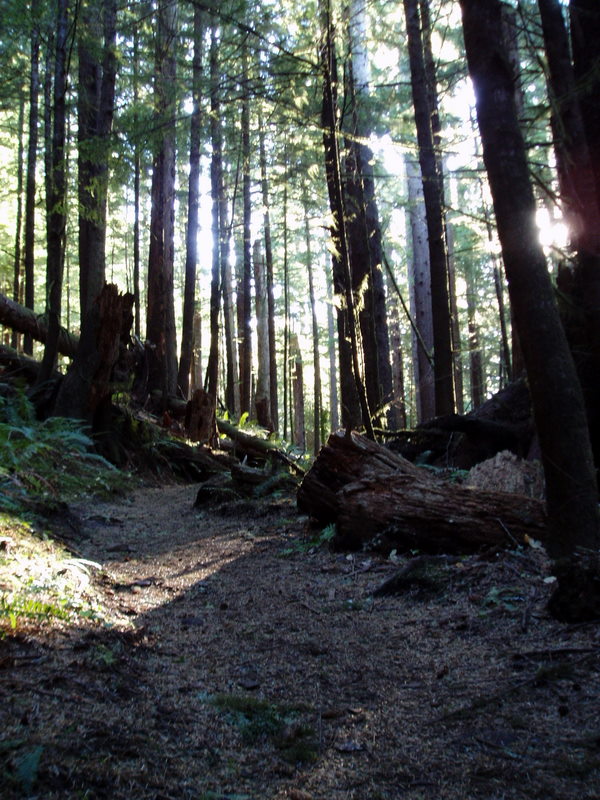

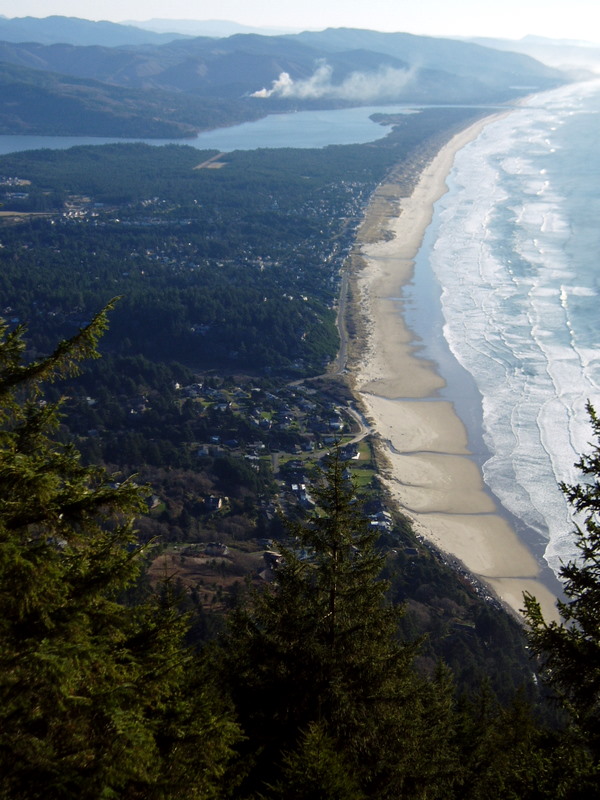
 Of The Hands