Author Archive
Today, I worked at many jobs. I woke early in the morning, in a freezing cold yurt under a pile of bedding, and allowed the alarm clock on my cell phone to ring multiple times. Eventually–knowing I needed breakfast, and knowing I needed to conduct the day’s business–I eased my way out of the warmth of my bed and into the extreme chill of the morning air, pulling on yesterday’s Carhartts (belt still threaded through its loops) and a fleece and an extra pair of thick socks, then walking–cold, stiff–to the main house both for breakfast and its small, lingering warmth from the previous night’s fire.
I ate a pair of duck eggs from the farm, bacon and toast not from the farm. I made coffee and filled my thermos with it. I attempted to wake up. Before leaving the house, as the sky finally began to lighten, I opened the duck and chicken houses, welcoming them to the cold world. The birds seemed largely unperturbed by the chilly weather: the chickens cautiously wandered outside in typical fashion and the ducks went straight for their pond plastic kiddy pool, though the coating of ice delayed their entry into its waters. Meanwhile, I drove to the farm down the road. There, the farm’s owners and I loaded six lambs into the back of their canopied truck and, shortly thereafter, I drove off with them–and with one of the farm’s owners, Brian, riding shotgun.
We were driving about two hours to a small butcher. Today was to be those lambs’ final day. As it turned out, it could easily have been Brian’s and my final day, as well. About half an hour into our drive, at perhaps 60 mph or a bit less, I lost control of the truck on a patch of ice on Highway 26, the main route between the Oregon coast and Portland. We spun 180 degrees and I have little idea of what I did during that spin. It was fast and slow–a bizarre meditation. I know I hit the brakes at one point and I think I let off them not long after, some small voice in my head telling me I shouldn’t hit the brakes. I don’t know which way I turned the wheel, if any. If I had moved quicker, with more certainty, with greater skill, perhaps I could have avoided the full spin and danger of that moment. But what little I did or did not do ended up not mattering. We simply spun around in a half circle, the tires squealing, the truck out of control and sliding out of our lane, into the lane of oncoming traffic, toward a hill side. I remember thinking, don’t flip over.
We didn’t flip over. No oncoming traffic hit us, either, as we had the good fortune of there being no oncoming traffic. We came to a stop in the left lane of the opposite direction of traffic. Having completed a bit over a half circle, we faced approximately in the right direction. I noted no traffic coming in either direction and I tried to start the car, which had died. It was still in drive and thus didn’t start, though I hadn’t yet recovered my wits enough to realize that. I knew we needed to get out of the road, to make sure we hadn’t lived through this spin only to get plastered seconds later by traffic coming around the bend a short way behind us. I let my foot off the brake and we coasted forward, which happened to be down the hill, and I guided the truck over to the side of the road.
Brian and I caught our breaths. We tried to calm our adrenaline and talked a moment about what had happened. At most, a minute had passed.
On the shoulder of the road, facing the wrong direction, I put the truck in park, engaged the parking brake and then checked on the lambs. They seemed fine–all upright and oddly calm. I can’t imagine they had enjoyed the ride, but who’s to say? I know not the mind of a sheep. Returning to the cab of the truck, Brian and I decompressed a bit more and then I awaited a full clearing of traffic to maneuver my way back out onto the highway. We had survived. We still had work to do. So back on the road we went–this time at a slower speed and with the four wheel drive engaged.
We made it to the butcher almost two hours later, due in part to my slower, steadier pace. There, we unloaded the lambs, picked up some stored cuts of beef, hit a nearby farm supply store to buy poultry feed and then headed into Portland. We met up with a chef and sold him twenty pounds of beef brisket. We ate at Burgerville–a local fast food chain that prides itself on using many local and seasonal ingredients and engaging in sustainability initiatives (see my previous post for related thoughts)–gassed up the truck and headed home.
After the trip back, I used the remaining hour of daylight to feed the awfully hungry ducks and chickens back on my home farm and then went down to the lower field, where I inspected some damage to the hoop house from a previous storm and replaced the blown-off row covering on our overwintering beets and carrots. I returned up top to the main property, closed up the ducks and chickens in the waning daylight, then brought firewood into the main house, fired up the stove, sat down with a beer, and promptly became distracted by the writing of this blog post.
Which brings me to now. So why did I just regal you with tales of my day? First, I wanted to write about the more exciting moment of spinning out of control on the highway. Second, I wanted to note a thought I had earlier this evening, when I was walking down to the lower field, which was that if I had died in the Great December Spin-out, and the six lambs in the back had happened to not only survive the wreck but break free of the back of the truck and escape into the woods, I would like to think that–should I have some form of post-life consciousness enough to note this exciting development–I would be supremely pleased, despite my own death. For all the misery we’ve heaped on the animal world as humans, why shouldn’t they get the last laugh now and again?
Finally, though, I couldn’t help but place my day today in the context of something I read last night. I’m currently reading The Ecotechnic Future by John Michael Greer, a masterful peak oil writer and Druid. In this book, he writes about the future he foresees for industrial civilization, which is one of contraction and collapse. He believes, as I do, that we are running out of fossil fuels and that, in the last three hundred years or so, we have built an industrial economy that now guides the world but can’t run on anything other than fossil fuels–which means that we’re in for some rough times ahead. There is far more detail to this story and I would recommend the book for anyone interested, even if you’re familiar with peak oil theories and have read other books about the subject. Greer takes an approach that I find unique and only 78 pages into The Ecotechnic Future, I find myself fascinated and extremely engaged by all the possibilities and theories he throws out in the text–many of which I likely will write more about on this blog in the future.
Anyway, Greer believes that in the not-too-distant future, we will all find ourselves living with much less (energy, stuff and stimulation) and scrambling to make our way in a new world. He writes, at the end of one chapter, that “Most of us will learn what it means to go hungry, to work at many jobs, to watch paper wealth become worthless and to see established institutions go to pieces around us.” Today seemed to me to be a small glimpse of that future reality. While I certainly did not go hungry (I ate as a glutton, though not in any way other than normal in this country) and my money still means something, I worked many jobs. I worked here at the farm I live on, I worked at the farm down the road, and all that work was varied and piecemeal–a lamb driven to the butcher here, some frozen meat sold there, a duck fed here, a row of beets covered there. I also simply lived meaningfully–bringing in firewood to provide heat and cooking, burrowing deep under my covers on a very cold morning. I also had small moments of joyful clarity–not just the very long seconds of spinning out of control and wondering if I was about to die, but also the moment when multiple small icicles slipped out of the hose along with icy cold water while I refilled the duck’s water jug. True, I drove far more than will be feasible in the future and ate fast food and drank both homemade and purchased coffee–also unlikely future activities–but I lived today a life that seems to hold something of a framework that will be quite relevant in the future. There will be exposure to the actual local climate, not just controlled environments. There will be close interactions with a variety of animals–many of which will be feeding us in some way. There will be both mundane and enlivening chores. There will be direct engagement in the production of heat, not just the turning of a switch. There will be moments when you will suddenly realize you might die, much sooner than you think, which Greer also notes in the sentence right before the one I quoted. There will be moments of wonder at the world around you and its beauty, both despite and because of its challenges. There will not be air conditioned or over-heated offices, nor will there be many highly-specialized careers. Most of us will again become generalists, and our work will be about providing basic needs.
I feel like I glimpsed all that today, and I must say that I enjoyed it. Of course, the future will be harder, but there is an undeniable joy in the immediacy of such a life–and that joyful immediacy will be more common even as the discomfort and challenge is more present. I enjoyed the variety of my day, the direct engagement of it, and the sense at the end that I had lived honestly, had even almost died, but had not just trudged and–other than at a certain literal moment–had not just drifted.
Today I worked at many jobs. Today I lived a future life.
Yesterday, I ate an organic, frozen pizza, bought from a grocery store owned by Krogers. I walked to this grocery store and, after purchasing the pizza, I placed it in my reusable, cloth bag to carry it back to the house where I’m staying. I also, yesterday, picked up some books I had ordered from a local used bookstore, then perused them at a locally-owned coffee shop, where I drank a mocha made with coffee and chocolate from across the world. I drank organic tea, also from across the world, at another small, locally-owned business later that evening, chatting with a friend. I did this after getting there on the bus and I returned home on the bus. I walked over five miles yesterday, all total. I ate two sandwiches–one of them a simple turkey sandwich, made with left-over, factory-farmed turkey from a family Thanksgiving, some Best Foods mayonnaise, and bread from a local bakery that uses sustainably grown wheat. The other sandwich was for breakfast, using the same bread, bacon from a local, Portland-based grocery store chain that focuses on local and organic foods, Tillamook cheese (sort of local, sort of not) and duck eggs from the farm I live on, still covered in duck shit. I made that sandwich using a cheap, non-stick pan.
While using that non-stick pan, I experienced a small moment of disquiet. As a non-Christian, I wondered if this was what blasphemy is to Christians: that enveloping sense of not right. I wanted to and should have been using a cast iron pan and, frankly, wanted to be using it on a wood stove, rather than a natural gas-burning oven. But I was not at the farm I call home. I was in Portland, in a house not my own–one without a cast iron pan or a wood stove.
Portland, for me, is conflict and contradiction. Sometimes–as that first paragraph may make clear–it’s practically schizophrenia. Yet it’s a city I love, and in some ways it’s able to at least partially satisfy my ideals. It’s brimming with small businesses, many of which proclaim goals of sustainability. Local and organic food is available almost everywhere (in the inner core) and many of the city’s restaurants and bars aspire to provide that same sort of local and organic food (to varying degrees of success.) The city has fine public transit available and is immensely walkable. It is, in fact, a joy to walk around Portland. The streets are quaint and typically tree-lined, the houses are adorable and often unique, there are other people out walking, the drivers are mostly courteous, and there are plenty of places to walk to. It is a beautiful city and people here are nice. It’s tied enough to the local landscape that you can be in the city without feeling disconnected from nature and it is, similarly, close enough to natural and rural areas that you can easily escape out to these areas for a more complete nature fix, should you need it. It also is a city that strives at every turn to make people who want to live more sustainably feel very comfortable spending their money and consuming a variety of goods and services, all under a veneer of sustainability. It is, as such, a contradiction.
I’m reminded of this whenever I come here. My trips into Portland are typically to see family and friends, to consume alcohol and good food, to socialize, perhaps to engage in a protest, and to spend some time walking around a city I love. Yet it takes me away from a current life on the farm that has reached a somewhat satisfying level of minimalism, coherency and simplicity. On the farm, I live off the grid, heat and cook using locally-harvested wood, eat lots of food grown and raised on the same land I live on or a nearby farm, and I stay much more connected to the land base. It’s not any kind of perfectly sustainable life–there are still plenty of inputs, imported foods, gasoline-powered drives, electronics, plastics of all kinds, and so on–but it’s pretty damn good and a hell of a lot farther down the road of low-impact than I’ve ever been before. It’s also incredibly satisfying, engaging and connecting, which leaves me happier.
Here in the city, on the other hand, I live on the grid, eat out, drink lots, eat a decent amount of packaged and prepared food, often drive a lot (in getting here and then getting around town on short notice) am much more divorced from the land base, am not around chickens and ducks, typically have no idea where my food came from and certainly didn’t help to grow it. I do this for a few days (or a week and a half, for my current visit) and then return to the farm, where I settle back into my simpler, normal existence and try to get my head back in order. Sometimes this takes awhile.
Mostly, though, what I feel here in Portland is that weird sense of contradiction and conflict. It’s a city striving toward some kind of sustainability, but it still wants to engage in the energy- and resource-intensive, industrial way of life. So everyone still goes out quite a bit and eats and drinks and consumes far more calories than necessary, indulging in deliciously rich food, but it seems okay because the eggs come from cage free chickens and the greens are organic and from a local small farm, the coffee is organic and shade grown and fair trade and micro roasted, and the meat isn’t factory farmed. Hell, it might even be 100% grass fed, depending on where you are. The beer is a microbrew, crafted in Portland or at least the Northwest, and perhaps from local, possibly organic ingredients. The breads are from a small Portland bakery. The businesses are small, and local, and I bet they support the Occupy movement. You can have it all!
Of course, I don’t think we can have it all, and that’s part of what’s driven me away from Portland. I love this city, but it can’t give me exactly what I want. I want a deeper and more immediate connection to the land. I want to live on it and engage with it and I find that extremely hard to do in the city. I want to have non-pet animals living with me. I want to live off the grid and generate my power on site. I want a wood stove! I love wood stoves! And I want to harvest the wood for that stove off the land I live on, or off a neighbor’s land, in some kind of a trade. I want to live slow and cities tend to live fast. I want to take my time getting somewhere and I don’t want distractions at every turn. Maybe most importantly, I want to live simply and be always attempting to bring my consumption down to a more minimal level, and that’s something that becomes almost impossible in a city which is constantly waving consumption-ready delicacies in my face and proclaiming them guilt-free. I am not a man with overwhelming self-restraint, especially in the face of food and drink. And even more especially when facing that food and drink while hungry.
So when I come here to Portland, I tend to give in to the delicacies, the indulgence, the gluttony of the city. I eat and drink and I buy books at local bookstores and I walk around this city and marvel at its beauty and I eye small and adorable houses for sale and wonder what it would be like to move back to Portland, to find some kind of well-paying job, and to just fall into this life of indulgence. It would be a uniquely Portland life, I imagine, conducted on a salary that would seem too small in most places and using less energy at home than your average American and with far more local and organic food being consumed and less TV watched and more small businesses patronized. But it would just be a shifting of the usual, unsustainable order. It would be better, yes, but still a mirage. Too much food and drink, too much outsourcing of the day-to-day of life, too much complexity, too much energy, too much money, too many resources, too little thought and consideration. Therefore, I always end up heading back–and not just because the likelihood of me finding a well-paying job in Portland is almost nonexistent. It’s because, as much as I love the indulgences and the contradictions of this city, I want the simplicity of my life on the farm yet more. I want the thought that I’m moving toward something more real. I want the connection and the coherency. I want the slowness, the sound of the rain on the roof of my yurt, the unique heat that comes from burning wood, the constant use of cast iron cookware, the constant cooking, the connection to my food, the mud and chicken shit and duck shit and all the dirty clothes. I want that life more than I want the food and the drink and the leisure and the indulgence because as much as I love all that, it’s not real.
The most authentic thing in this house, as a matter of fact, may just be the dried duck shit on the eggs in the refrigerator. I love this city of contradictions, but I’ll be glad to go back to the farm where that shit came from.
A major storm hit us today, dropping multiple inches of rain–including one particularly insane stretch of a downpour–and sweeping heavy winds across the farm. Facing such inclement weather, Brian decided to fire up the hot tub, which sits under a roof as part of the farm’s solar bath house but is otherwise exposed to the outdoors, making it a particularly alluring experience on a night such as tonight. The extreme comfort and relaxation of soaking in hot water contrasts nicely with torrential rain and driving wind–the discomforts of a particularly cutting storm.
While the rain had tapered off by the time I was soaking, the south wind had kicked into high gear. Occasional, loud gusts would swirl around me, the air cool and insistent and charged with an uncommon power. As the gusts hit, I found myself sitting up in the hot tub, exposing more of my upper body so I could feel the air–that energy, that coolness–and revel in the juxtaposition between it and the hot water that otherwise engulfed me. This juxtaposition of sensations reminded me of the often-noted idea that to appreciate something, you have to experience its opposite. The comfort of that hot water was, in a certain way, offset by the blustery cold of the wind. By raising my body from the hot water to feel the cold wind, I better appreciated and experienced both sensations–either one heightened by the contrast with the other.
The way the hot tub is heated, at least in the winter, is via a wood-fired stove. Water siphons through an intake pipe near the bottom of the hot tub, heats as it circulates through a pipe in the stove, then streams out of an opening above the intake. The water continually circulates, slowly heating the entire tub. The water coming out of the stove eventually becomes extremely hot and, as you sit in the tub, a layer of that very hot water forms at the top of the tub if you’re not circulating the water yourself. This layer makes itself particularly apparent when you sit up, as your upper body passes through that hot layer, creating–for me at least–a tightening of the chest and a brief moment of discomfort and shortness of breath. It’s not so extreme as to feel dangerous, but it provides a juxtaposition between the hot and the very hot, the comfortable and the uncomfortable.
As I experienced these contrasting sensations–the differing levels of hot water, the hot water and cold wind–I couldn’t help but again think of the ducks. The storm-heightened comfort of the hot tub seemed another version of my musings on the ducks. Their seeming ability to stay comfortable in the storm (and based on my observations today, they were plenty enjoying the storm) spoke, I imagined, to their enjoyment of it. Similarly, I spent the rainiest stretch of the day in my yurt reading, with the wood stove going, luxuriating in the warmth and the deafening sound of rain pounding upon my little home. This was the height of comfort for me: another good book, a dry wood-burning heat to contrast the drenching rain outside, and the understanding that the deafening roar around me was cold, nasty, driving rain that I did not have to be in. I had my warmth, I had my shelter, and I had my comfort even as all the opposites raged outside.
This, then, is part of the beauty of living simply, even of living in what can be defined as poverty. By living in a yurt–a very simple structure–I stay connected to what is happening outside. I hear the wind and the rain, I feel the cold and damp if I don’t have my wood stove cranking and I can very easily bring in a warm summer’s night breeze by opening the door and cracking the dome on the roof. Outside activity is accessible to me. In most houses, that isn’t the case at all. Rain often cannot be heard at all, unless it’s particularly heavy, and it’s the same for wind. What’s happening outside can easily be a mystery. Climate control, as well, can negate the impacts of the heat and the cold, keeping an even temperature at all times. In fact, the act of heating or cooling a space is often not an act at all, but an automation, maintained by machines with only the barest of provocation of humans: the turn of a thermostat. I can certainly heat my yurt, but it involves me actually building and maintaining a fire, and is thus a conscious act rather than an automation. As such, it helps to keep me in tune to what is happening around me. It makes me think about my comfort and to take responsibility for creating it.
I think this is good. And I think climate control is in many ways bad. In attempting to automate comfort, we lose sight of it. In living in environments in which comfort is a constant, we forget what comfort is. When it’s always 72, you cease to appreciate it. When it’s always warm inside while cold outside and always cool inside when hot outside–and you never play a direct role in making it so–then you often cease to even understand what hot and cold is. You become a slave to constant, moderate temperatures and your body loses much of its ability to adjust to anything else.
We’ve built, purchased, engineered and automated comfort to such an extent in our society, I think we’ve lost sight of what comfort is. We need the contrasts–the juxtaposition of comfort and discomfort–to keep us attuned to the reality of comfort and to allow us to appreciate it. We need cold mornings so we can burrow into–and fall in love with–our warm beds. We need the sound of rain on the roof–not to mention an occasional, or perhaps regular, drenching–to appreciate being warm and dry. We need, too, the actual act of creating our comfort so that we can understand it as something we do for ourselves, rather than something that just occurs, automated, always. Comfort is special and resonant and it can only remain that way if we don’t normalize it, don’t automate it, and allow ourselves to be uncomfortable at times. We need that juxtaposition so as not to slip into a life of sleepwalking, divorced from sensation and severed from true contentment.
Today was supposed to be a particularly stormy day for us here on the Oregon coast. Up to two inches of rain was forecast, along with high winds. I found myself looking forward to this. While we’ve certainly had a fair number of rainy days since fall set in, we haven’t had a two-inches-of-rain sort of day. I imagined hunkering down in my yurt, the wood stove fired and keeping out the chill, listening to the pounding rain as I immersed myself in a good book.
While the storm didn’t end up being quite the rager as originally predicted, I did find myself hunkered down in my yurt for the first part of the day, along with the aforementioned good book, the hot stove, and the sound of rain all around me. We didn’t get the advertised two inches and the winds didn’t kick in until later in the afternoon–and weren’t as bad as predicted, either–but the rain was heavy enough to turn at times cacophonous and create a mesmerizing aural and visual backdrop.
Within that visual backdrop, not far from my yurt, were the farm’s eight ducks. (It used to be 14, but one or more raccoons recently gained a couple meals from the flock, sadly.) As I noted on Twitter a few weeks back, our ducks and chickens have different, distinct reactions to stormy weather. While the chickens tend to huddle under a tree or simply give up and go to bed early when it’s particularly rainy, the ducks grow ever more active and ecstatic as the rain increases. A torrential downpour and furious wind seems only to encourage them–to set their stubby tails wagging with greater energy and frequency, thier beaks digging beneath grass and weeds with ever more purpose and conviction. When I let them out of their house this morning, they ran out into the wet, cold and wind with a joy and abandon I couldn’t help but find contagious. They bobbed their heads, wagged their tails, searched for bugs and quacked heartily at each other.
As I watched, I couldn’t help but to wonder what it might be like to be a duck in a rainstorm. Their joy spoke to something natural–to a sensation that surely must fulfill whatever innate sense they hold as to what it is to be a duck. And I couldn’t help but wonder if being a duck in a rainstorm is not unlike a heightened sense of me being myself in a warm yurt in the same rainstorm. As I curled up later that morning with a good book, a fire crackling in the wood stove and heat radiating from it, listening to the rain hit my yurt but staying dry within, I felt a deep comfort from knowing what could be and having, instead, the opposite–existing within the best definition of coziness: a small warm space protected from the cold and wet beyond. What if being a duck in a rainstorm is simply a greater version of that sensation? Imagine the wind whipping around you, the rain drenching you, but your body being impervious to it. The rain runs harmlessly off your feathers and the wind slips around you, no better able to penetrate those feathers than the rain. You are warm and you are in your natural element–wet, perhaps a bit muddy, but comfortable. Not only is the wind and rain unable to touch you, but it invigorates you. Its power and primacy is potent, yet it brings you only comfort and joy. The raindrops feel good as they slide off you, providing a pleasurable sensation engrained deep into your genetics, triggering that sense deep within that comes whenever you bob upside down in a body of water, searching for food–perhaps even mystery–flowing that water over you, eating and drinking and feeling, engaging. To be a duck in a rainstorm–is it like a long, hot shower or a soak in a hot tub on a cold night? How does that feel?
I wish I knew. I know I like to be in a small, warm space when it’s raining outside, able to hear the hit of those drops but not having to feel the discomfort of being cold and wet. I know I like being in effective rain gear in a storm, able to feel the vibrations of the raindrops hitting my gear and feel the wind against my face, pressing against my body, but not suffering the cold and wet discomfort of being exposed. But what would it be to be naked and invulnerable? To be able to feel it so much more directly, yet still maintain your comfort?
Surely it would be exhilarating.
When I watch our ducks in the rain, I feel that–small and incomplete, but joyous just the same. I stand in the rain long enough for a smile, for a few moments of shared pleasure, and then I retreat back to my warm home–to my good book and the muted echo of rain and all that infrastructure of dry comfort.
That’s right, Of The Hands has returned from its (my) self-imposed hiatus. The farming season has wound down, the CSA is finished, the cold and rain have set in and winter looms large. I suddenly have a whole lot of free time and plan to use it to get back into the writing. I also have been using it to get back into the cooking (not that it ever really stopped.) Last night, I made a lamb stew and tonight I dived into some good, old-fashioned pizza making. Tomorrow I’ll have a real post for you. Tonight, you’ll have to do with some dinner pictures.

Winter squash sauce with caramelized onions, chanterelles, roasted garlic, goat cheese and sage.

Roasted tomatoes, pesto, some stray caramelized onions and chanterelles, goat cheese, parmesan and romano.
I made a mistake.
I started a blog in the midst of summer, while farming, and while perilously close to–at least temporarily–hitting a physical and emotional wall. Surveying my life, I’m now realizing that I can’t keep updating this blog for the moment. Life is a bit busy and stressful at the moment, both with work and personal issues, so this blog will have to wait.
It seems odd to write that only two weeks into the blog’s life, but this is the reality. I do intend to return to Of The Hands, though–likely in a few months, once fall has arrived and the farming life has slowed down a bit.
I apologize for the false start. I will be back, and if you’re curious enough to know when, feel free to sign up for the email list to the left. You’ll receive an email the next time I post.
You can also keep track of me through Twitter and Facebook. I’ll still post occasional updates via those venues during the hiatus.
Tonight we’re making chicken soup with the bones of two raised-and-slaughtered-on-the-farm chickens that we cooked up over an open fire last night. The soup’s being cooked on our rocket stove, which was made here on the farm utilizing clay from the land.
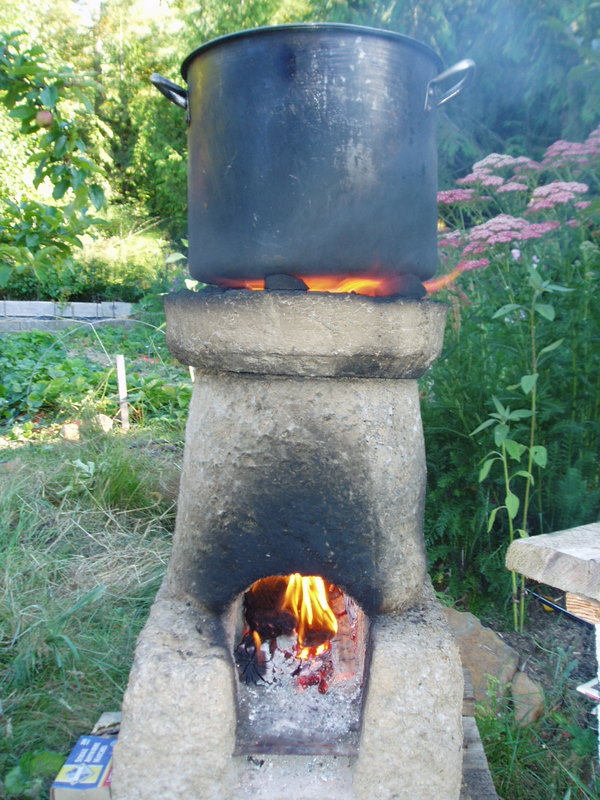
Cooking off-the-grid style, using a rocket stove made with clay from the land and burning pieces of scrap wood from around our wood shed. Chicken soup is indeed good for the soul.
An entry in Encounters
I already wrote about the abundance of life here on the farm. It’s evident everywhere you look: the plants tall, bushy and vigorous, the crops yielding fruit and leaves, flowers and roots, the earth crawling with tiny creatures, winged friends singing and flying all over the place and the sun presiding over it all. Yet, while the macro is impressive, the micro yields still more to see. In fact, it presents the details–a face that in some ways is perhaps more true than the broad view of the beautiful fields and towering trees. That broad expanse is a picturesque one, fitting into a societal standard of beauty, suitable for framing and for the common oohs and ahhs. On the small scale, though, amongst the cracks and crevices, the more intriguing realities come to the forefront and the reality of just how rich and diverse the life is here becomes apparent.
A moment ago, I heard a commotion in the seedling house attached to the western wall of the main house. Inside this small greenhouse we have seed trays of fall starts sitting on shelves and raised beds on the ground, currently filled with our eggplant. There are three raised beds, one in the middle and then one on each side, with a few inches of space between the raised bed and the greenhouse’s wall. The motion that attracted my attention came from the bed to the left of the entrance and I could immediately tell it was a bird flying amongst the eggplant.
Curious, I stepped inside and knelt down to peer into the plants in search of the bird. I couldn’t see it at first and thought it had found its way out of the eggplants and into a corner, but then it revealed itself within the plants, clamoring away from me, back toward the front of the greenhouse, its movements erratic as if the bird’s body was broken. As I found its position and was able to focus on the small creature, I could tell that this was indeed the case. It lay on the ground, close to the edge of the raised bed and near the greenhouse’s western glass wall, breathing fast, faced away from me but its head turned so that it could keep an eye on me. Its legs spread out flat behind it, seemingly broken. I spoke to the bird for a moment and then–and I don’t know if this is defensible–took my camera out of my pocket and took a picture of the bird. It continued to watch me, wary. I spoke again and thought about the cats, that one of them likely had done this to the bird.
Unsure what to do, I stood and moved toward the bird. I would have to pass it to exit the greenhouse anyway, and I thought perhaps I could pick it up and take it outside. Upon my movement, though, the bird attempted to fly forward again and fell into the couple inch space between the raised bed and glass wall. It was now out of my reach. The bird’s fate was its own–which seemed appropriate, anyway.
Still curious, however, I moved up to the front entrance and peered into the space between the raised bed and the southern wall, to see if the bird had moved far enough forward in its space to be seen from that angle. For a split second, I thought it had, but then I realized it was not a bird I was seeing, but a chipmunk. It crouched silently in that space, facing forward, about a foot in from where I stood, staring at me while very still. I watched it for a few moments, meeting its eyes through the tangle of cobwebs dotted with dirt and small bits of plant debris, the emptied husks of caught insects. The dry body of a familiar caterpillar dangled right at the edge of the space. A few inches further in, a spider waited, curled up into a ball and pressed against its egg sac. In this small space, the chipmunk–normally such a small animal when seen in our more familiar open spaces–was a hulk, a strangely-large beast hunkered down but still filling an inordinate amount of its limited area. From this perspective, as well, I could feel myself as a giant. I ceased to be the below-average, five foot five inch human being and became instead something massive. Peering into that space, I actually entered it and became–for a moment–that chipmunk, peering back out at me through the crisscrossing cobwebs, this strangely-thin insulation. I became a mass, giant and threatening, my head alone far bigger than the chipmunk. I lost myself in that moment. My change in perspective–with the orientation of my view so much closer to the ground than normal and my up-close view of the cobwebs growing them to a size far greater than I would normally perceive them–and my discovery of a new place far more complicated and full of mystery than I had anticipated transported me into the body of another creature, into a view of the world not my own.
There was a magic in that moment spoken of by David Abram in an interview I had just read earlier this morning. In the interview, conducted by Derrick Jensen and published in How Shall I Live My Life?, Abram spoke of the importance of using magic to alter our perspective and jolt us into a renewed awareness of our interplay and interconnectedness with the living world. A sleight-of-hand magician, Abram said that “magic is an experience. It’s the experience of finding oneself alive inside a world that is itself alive. It is the experience of contact and communication between oneself and something that is profoundly different from oneself: a swallow, a frog, a spider weaving its web. . . . Magic is that astonishing experience of contact and conviviality between myself and another shape of existence, whether that be a person or a gust of wind. It’s that sense of wonderment that arises from the encounter with that which I cannot fathom, with something that I cannot ever fully exhaust with my thoughts or understanding.”
The surprise of seeing that chipmunk–what is she doing there?–shocked me as a sleight-of-hand trick might, causing me to question the world around me and my knowledge and awareness of it. I went looking for a bird and found, instead, a chipmunk–and a spider, and cobwebs, dirt and debris, drained insects, and more. I discovered an entire other world and–left unbalanced by the surprise of an unsuspected presence, my perception altered so that small things seemed bigger and a tiny space that could not fit me filled the entirety of my vision–I entered that world. Through a co-authored magic born of contact, I fell into the chipmunk, the primary focus of my attention, and entered into an otherworldly alteration, discovering my place anew and seeing myself as the other, as something astonishing.
It was not only an experience of wonder, but a subversive moment, as well. As humans, we spend so much time in a human-centered world. We tend to live in human-built buildings, exist in human-built environment, transport ourselves in human-built devices. We speak with other humans but rarely speak with nonhumans. We see, constantly, as humans, and rarely take the time to attempt to see as nonhumans. But this is not an impossibility. An alteration of perspective, a sudden surprise, the magic of the unexpected–these experiences can transport us better than any car, subverting our human experience, opening a door into the nonhuman world and reminding us that not only does that world exist, but that it is the world and we are simply of it, within it, not separated from or above it.
Today I was transported in just such a manner. I discovered a bird and ended up becoming a chipmunk. It was an astonishing trip, brought about by a special kind of magic and grounded within the sudden contact between human and nonhuman, between myself and the other, between two manifestations of life–both of them unique, authentic and valuable, both of them with their own perspectives of the world. I’m grateful that today I was able to experience both those perspectives, rather than just my own. I’m grateful that today I peered into a small, forgotten space and discovered magic.
Yesterday, after we harvested for the market, I headed out to the coast for a relaxing afternoon of food, beer, reading and writing. I went to a particularly treasured spot and thought I would share a couple pictures.
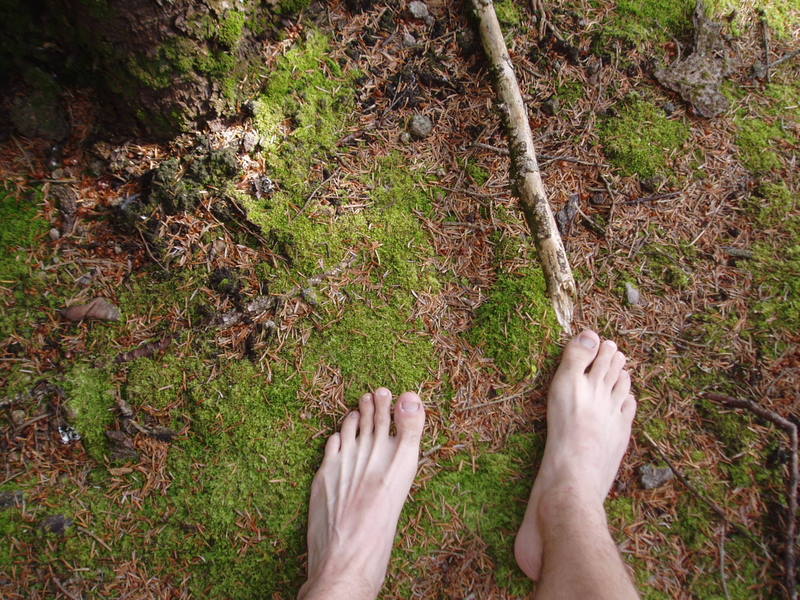
The moss felt so soft.

Looking up the hill from where I stood barefoot.

Looking toward Cape Falcon.

A favorite hang out spot for gulls and other birds.

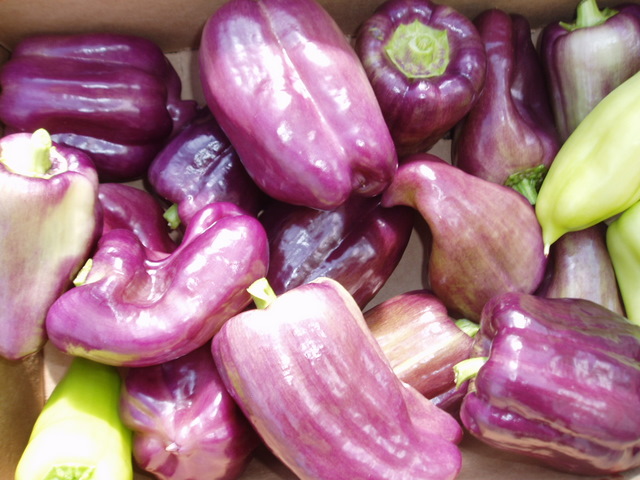
Purple peppers are just cooler.
Yesterday, Brian told me to watch the moon that night. Its track across the night sky would be a preview of the sun’s track during the winter. The moon would show me how little sunlight we would have.
And indeed, the moon’s track was low on the horizon that night, skimming along just below the tops of the trees upon the ridgeline on the southern side of the property. Shafts of moonlight would occasionally flood the farm as the moon slid into an open space between two trees, but it would soon disappear again. The overall message was clear: those trees, while quite effective in shielding the farm from wind during storms, are also effective in shielding the farm from sunlight in the winter. It’s going to be a dark winter.
This understanding serves to make me appreciate the farm’s current abundance even more. As I wrote a few days ago, the sun provides the farm with an incredible amount of wealth: food, energy, warmth, pleasure. It transforms the land and the life upon it, including us. It helps to provide an almost unimaginable abundance.
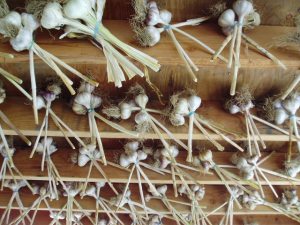
Garlic hanging to dry.
We have so much food right now. Nearly every meal seems a ridiculous spread, each day a testament to the current bounty. The farm is now pumping out cucumbers, eggplants, peppers, tomatoes, basil, squash, beans, carrots, beets, and potatoes. Not to mention kale, chard, salad greens, arugula, spinach, head lettuce, garlic, broccoli, cabbage, radishes, parsley, blueberries, and I think there may be a few stray strawberries around, too. The chickens are providing their own abundance in the form of multiple eggs a day. Brian, meanwhile, has been catching Chinook salmon, providing us with incredibly delicious fresh fish. Ginger has been trading at the farmers market, using our incredible veggies to bring home cherries, peaches, raspberries, locally-baked breads and pastries, local milk, blue cheese and grass-fed meat. Before long, we’ll have melons, corn, another round of snap peas, duck eggs, wild blackberries, honey from Ginger’s hives, and a few apples from the still-young orchard.
It’s not just the food, either. The farm is blanketed in beautiful flowers and the growth of everything (including the weeds) has exploded. There are birds everywhere, the cats are playful and energetic, the chickens and ducks are ever-busy, and uncountable wild creatures, bugs and critters abound. Thanks to the sun, we usually have abundant electricity and hot water. And, finally, we find ourselves with a never-ending stream of engaging, thoughtful, hardworking Wwoofers.
While farming is a joy year-round–even when the cultivated food has yet to arrive–it’s particularly satisfying this time of the year. When the incredible abundance arrives and you find yourself with an almost embarassing selection of delicious, fresh, healthy foods to choose from every day, the true glory of being a farmer–of this way of life–makes itself clear. This, here, is one of the many rewards of good work. Not only abundant and delicious food, but the forging of community and the fostering of life, health and happiness. While it may prove a dark winter, the memory of such a bright and sustaining summer will no doubt carry us through.

The summer makes kittens playful and keeps them adorable.




 Of The Hands